
A survey conducted by news.com.au after the 2023 Women’s World Cup, revealed that the Matildas ranked 2nd (22.8%) behind the Australian male test cricket team (31.2%) as Australia’s favourite national sporting team. As cricket in the Australian summer dominates the population’s interest, this is not surprising, however that the Socceroos came in 6th with a miserly 6.4% of the vote, should be of concern to the game’s administrators. Considering that the “world game” ranks first in sport participation numbers nation wide, the question needs to be asked as to why our national men’s football team is graded so lowly in the popularity charts? Why does a team that performed so creditably at the 2022 FIFA World Cup have such a modest popularity rating?

Despite the 2022 World Cup heroics, the Socceroos, with a couple of exceptions, remain a team of unknowns, strangers to local football followers. Unlike the Matildas who have genuine star players in Sam Kerr and Mary Fowler, the Socceroos squad is bereft of true quality performers and the majority of the team are playing in lower football divisions overseas. For most Australian football fans, it is a case of out of sight, out of mind.
After the Women’s World Cup, Australian penalty shoot out heroine, Cortnee Vine asserted that more needs to be done to retain elite women footballers in Australia, including better remuneration. Clearly the same applies to their male counterparts. Cortnee went on to say “I think that its’ so important for our faces to be here. We represent this country, I think it’s so important to be part of the domestic league and to show the girls that this is the way we go”. Too true Cortnee!
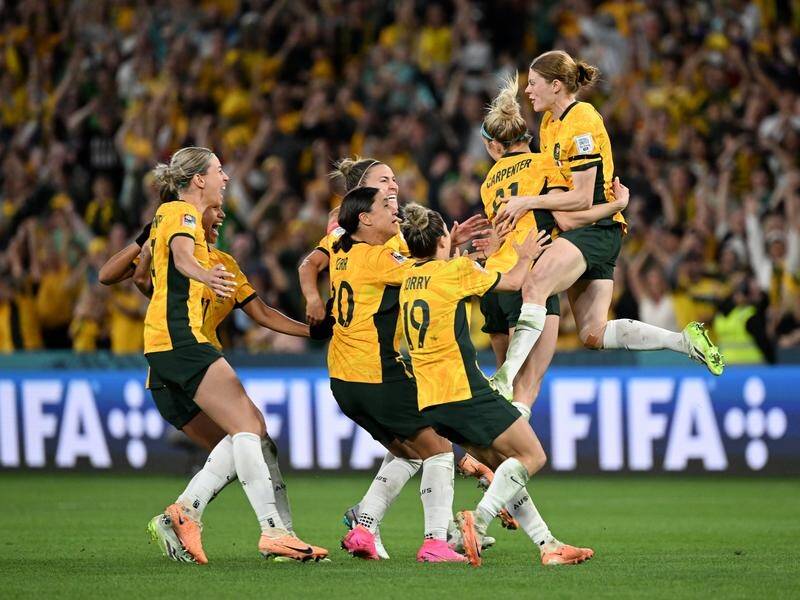
In the six weeks or so of the Women’s World Cup, the Matildas received large scale exposure and their engagement with the media and their winning over of the public, was a lesson that the male footballers would do well to learn. The Matildas also won many friends with their approach to playing football. The women’s game is more free flowing, less aggressive and tackles less cynical, than those of men’s international football. On many occasions, I even saw the girls laughing and appearing to be enjoying the game! What limited engagement we have with the Socceroos is usually standard post match interview responses, where the stock phrases are rolled out and typically “all credit to the boys” is offered. The Socceroos popularity is critical as it feeds into merchandising, ticket sales, player registrations and keeps the broadcasters happy. All of which helps the coffers of the reputedly cash strapped Football Australia.

In announcing his twenty six man Socceroos squad for the 2024 AFC Asian Cup in Qatar, coach Graham Arnold included a certain Gethin Wynne Jones as one of the selected players. Like myself, thousands of Australian soccer followers were asking the question, Gethin Who? Gethin Wynne Jones (it doesn’t get more Welsh than that!) has played for 7 English football clubs in 9 years, fleeting between the Championship and Leagues One and Two. Jones is presently playing for Bolton Wanderers in League One, effectively the third level of professional football in England.

In 1950, an essay “The Cultural Cringe”, referring to Australian literary works, proposed that “in any nation there should be an assumption that the domestic cultural product, will be worse than the imported article”. Australian soccer has always suffered from such a cultural cringe and continues to be infected by it today.
Certainly, this was true with Australian club football from the 1960’s onwards, evidenced by the scores of second rate British imported players, filling team spots that could just as easily have been taken by locals. We still see this in the Isuzu Ute A League, where imports / “visa” players frustrate the ambitions of the local players. There are a large number of exciting local players currently with A League clubs (Brisbane Roar is a good example), however most are just not getting enough playing time, due in part to the presence of visa players imported from lower divisions overseas.
The cultural cringe is patently evident with Socceroos selection. Apart from a couple of exceptions, playing anywhere outside of Australia, be it in the second divisions of Norway, Germany or Japan is considered a better “article” than the local product, the Australian professional football competitions. Or, in the case of Asian Cup squad member, Marco Tilio at Celtic, scarcely playing at all overseas is preferable to scoring hat tricks in the A League. Nevertheless, I do consider Tilio a very talented footballer.

Getting back to Gethin Jones, is it reasonable to assume that there may be local Australian footballers more deserving of a place in the national side than a 28 year old English lower divisions journeyman, who states unashamedly that he is 100% Welsh? At his recent press conference after the announcement of the Asian Cup squad, Graham Arnold stated that “we have been very impressed by Gethin’s form.” I would ask the question, “how difficult is it to impress as a right full back in the third level of English football?”
There have been a number of “strangers” who have been elevated to the national team ranks in recent years, emphasising the cultural cringe ethos. Martin Boyle, Harry Souttar and Cameron Burgess were all born in Scotland and never played club football in Australia. We didn’t know them nor their footballing background and is it any wonder that the Australian public rank the Socceroos as only their 6th favourite national sporting team?
Once a player is picked in the national team, the effusive Australian TV media, with their superlatives and patriotic commentary, can turn an unremarkable thirty year old Scottish winger or a 28 year old Welsh full back into Australian football superstars. Don’t expect objective analysis either from the barely visible football print media and on line reporters. Journalistic scrutiny and objective assessment of Australian football has long gone.

Graham Arnold seems to manage the ancestry.com jibe amiably enough these days, but it is sad that the coach feels that he has to recruit players, with fragile links to Australia, to fill the Socceroos ranks. How annoying too, it must it be for a precocious talent such as Adelaide United’s 17 year old Nestory Irankunda to be overlooked for John Iredale. The latter’s team SV Wehen Wiesbaden, are in the bottom half of the German second division having been promoted from the third division in 2022-23? Iredale, a former Sydney FC player, has a meagre goal tally in Germany, however he has been selected ahead of Melbourne City’s Jamie Maclaren, whose prolific goalscoring form continues – but in Australia. Admittedly, Melbourne Victory’s Bruno Fornaroli was selected in the Asian Cup squad although the Uruguayan born striker’s astounding A League goal tally this season, demanded selection.

Of course, Australians dating back to Joe Marston and Ken Greives in the late 1940’s, have chased football careers overseas, primarily in England but also throughout Europe. Some did achieve a good measure of success, certainly Marston, Craig Johnston and the “Golden Generation” of Kewell, Viduka, Bosnich, Cahill and Neill, but many who ventured overseas found that ultimately, there was no place like home and these returned to play in Australia, well before their twilight years. Playing in the premier English leagues, Johnston and the majority of the Golden Generation were very visible. Additionally, most had spent their formative football years in Australia and when they were playing in the top English divisions, their familiarity with Australian football fans was guaranteed.

The 1973-74 Australian World Cup squad comprised a team most of whom were born overseas, however they all played their club football in Australia, not in the lower leagues of Norway, Germany or Japan but at local suburban grounds. These grounds may not all have been ideally suited for football but in Sydney, at venues such as Arlington Oval, Lambert Park or Bossley Park, you could lean over the fence and hand the ball to Ray Baartz, Johnny Warren or Ray Richards. If you lived in South West Sydney, you might have been lucky enough to have had your milk delivered by Manfred Schaefer of St. George and Australia. We knew these players and even without TV coverage, international players had a major presence in the country. This may have been from turning out regularly at Middle Park or Olympic Park, Melbourne, possibly appearing at school holiday children’s coaching clinics or as guests on local television sports shows.
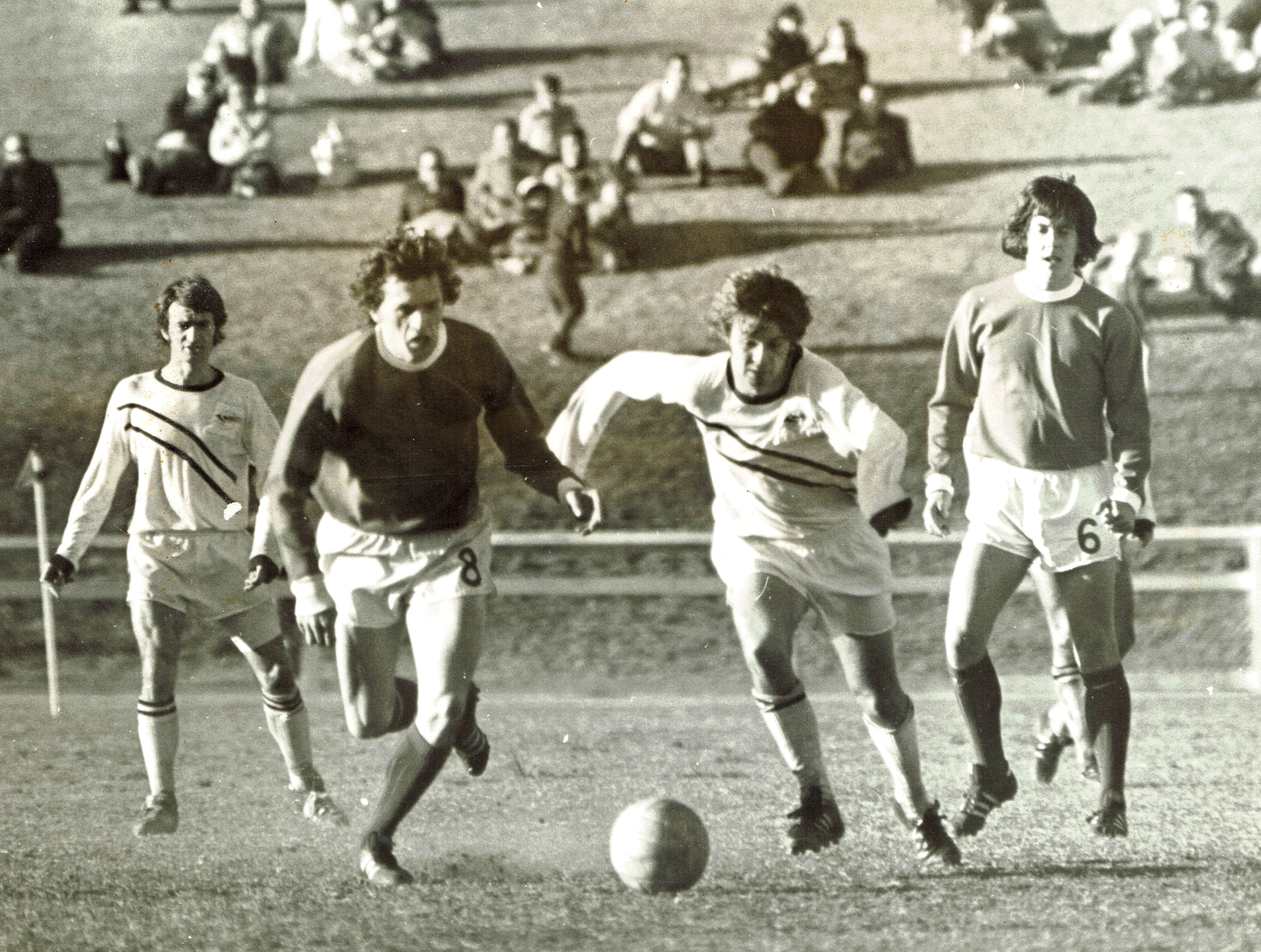

We play far too few international matches in Australia, again an important way to help fans connect with the Socceroos. Even when not constricted by international breaks, the national team plays Argentina in China and Mexico in Texas ? There are a number of Asian nations that would provide stiff opposition for Australia and how hard would it be to play a mid week game against our New Zealand neighbours. If overseas based players could not obtain a release from their clubs, there would be plenty of others here, keen to represent their country. I’m sure that Australian football followers might warm more to the national team, if we could watch them play more often, not just in occasional World Cup and Olympic Games qualifying matches against the likes of Bangladesh and Lebanon.
Australia has a huge number of registered footballers and it is imperative that we cash in on the volume of grassroots players and have them embrace our national football teams. For this to happen, we need more national team players turning out regularly here in Australia. Too many local players head overseas mistakenly thinking that the overseas grass is always greener. To stop the export of our best talent, it is imperative that Australia has seamless, vibrant professional competitions that are fully connected through promotion and relegation. Where every match counts and 16 and 17 year old players consistently have the opportunity to compete with the country’s best.
Until those competitions materialise and player’s salaries increase, it will be hard to avoid local players seeking football and financial fortune overseas. In the meantime, let’s give more national team opportunities to those playing locally and cease this cultural cringe mentality where the local player is frequently considered inferior to the “strangers” playing overseas. Then, the Socceroos might find a greater slice of the nation’s love.
David Jack © 2023

 David Jack