David Jack is a football enthusiast, living in Sydney, Australia. His father, also David Jack was a respected football writer for 40 years both in the U.K. and Australia. David has been active in the finance industry for many years, plays guitar and is a big fan of 1960's music
In 2022, David completed his first book, "In Search of the Great Australian Dream" - The Simple Guide To Home Loan Finance
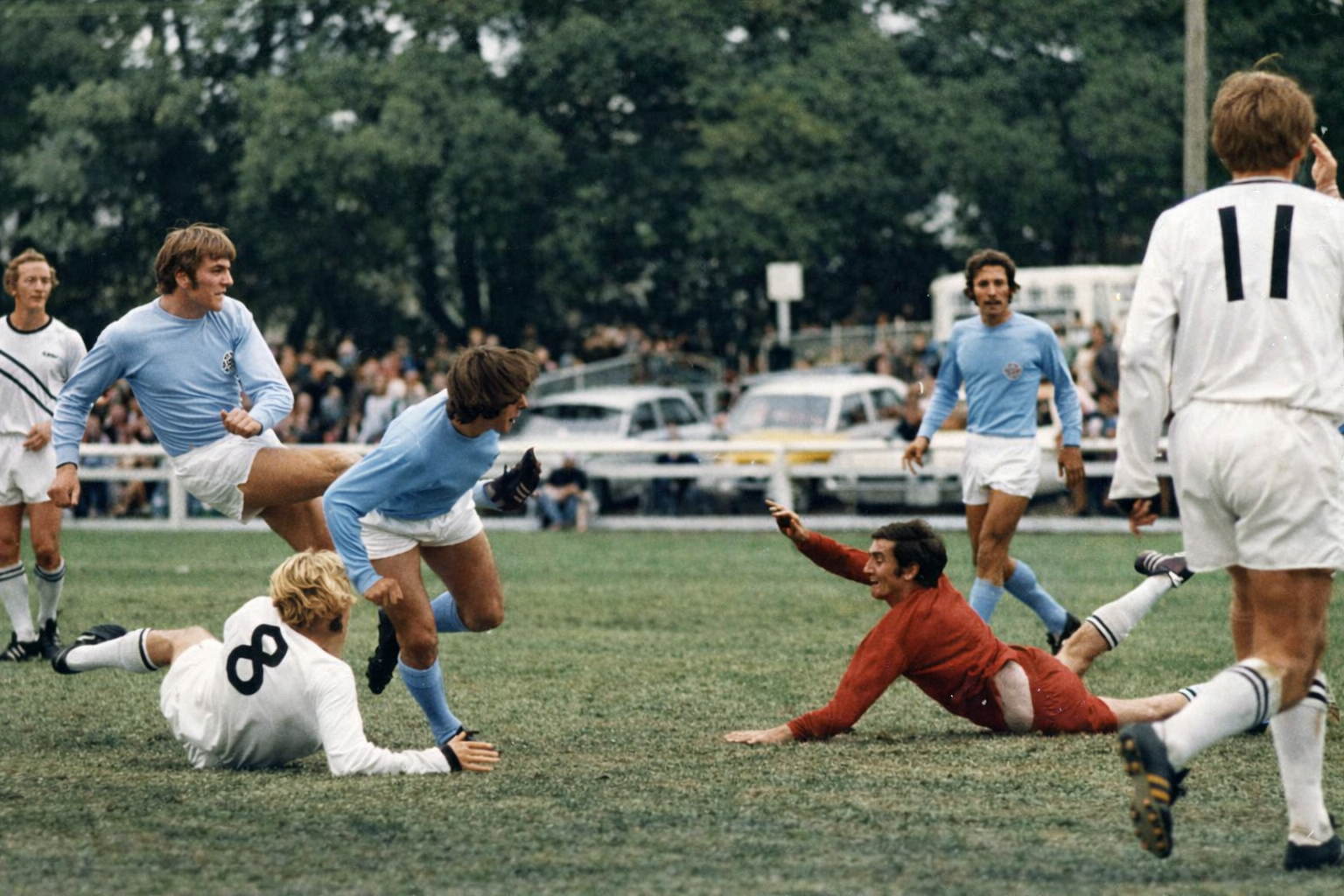
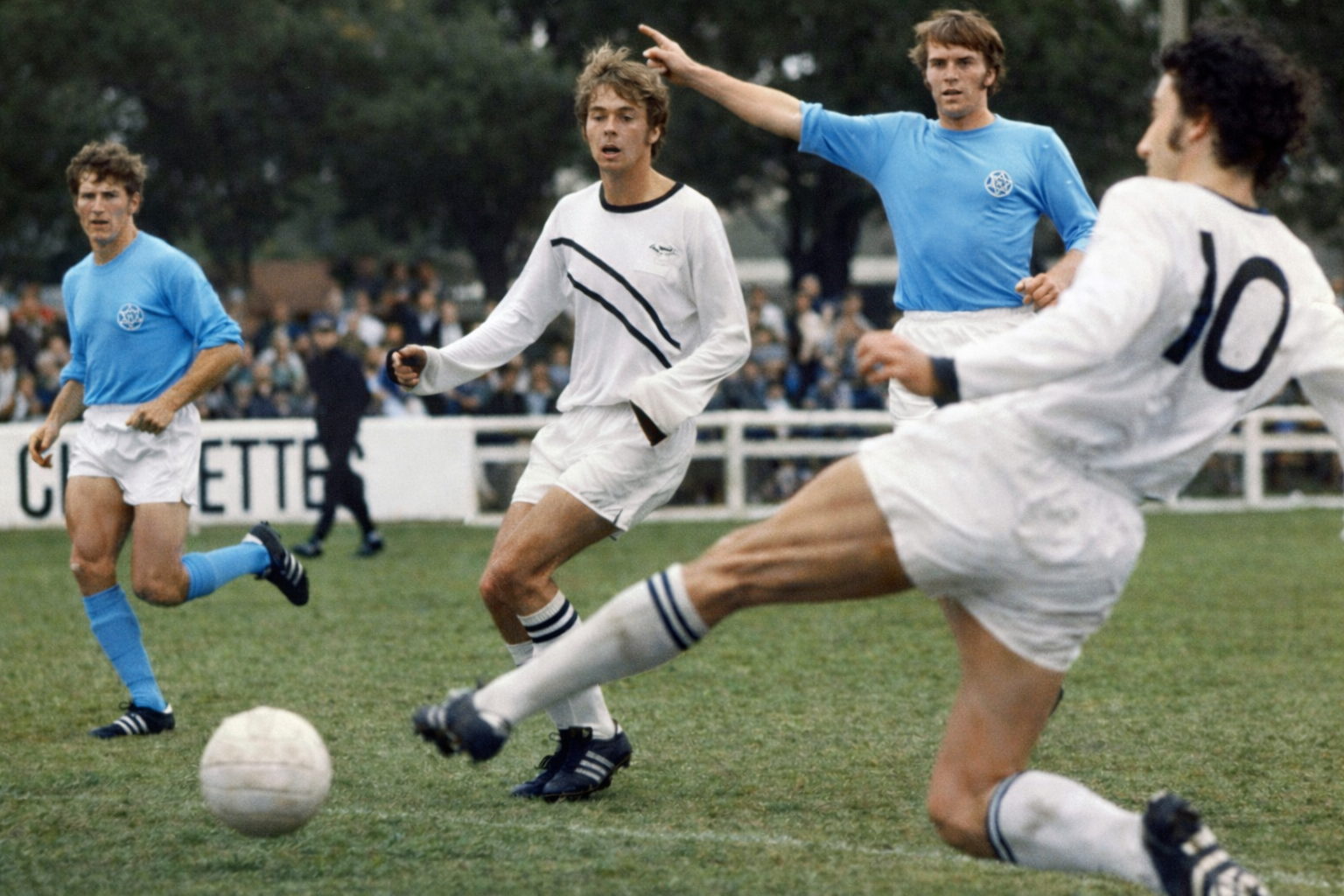
Western Suburbs 1 ( D Jack) Hakoah 3 ( A Marnoch, G Yardley 2)
Allan Marnoch scores the equaliser for Hakoah as Archie Blue, Greg Smith, myself and Hilton Silva look on
In June 1971, Australia was witnessing mass protests around the country against the Vietnam War and the apartheid South African rugby tour, Gough Whitlam, then Federal Opposition leader controversially was about to visit China and Daddy Cool were soaring up the local pop charts with “Eagle Rock”.
On the local football front, the consistently strong Hakoah side travelled to Drummoyne Oval to play my team, the NSW Federation Division 1 upstarts, Western Suburbs Soccer Club. Wests newly promoted to the first division, had surprised football followers by winning the 1971 pre season Ampol Cup 4-2 against Marconi in January of that year. Proving that they weren’t going to be also rans in the competition proper, a string of impressive performances had Wests in second place behind Hakoah prior to the Drummoyne Oval encounter.
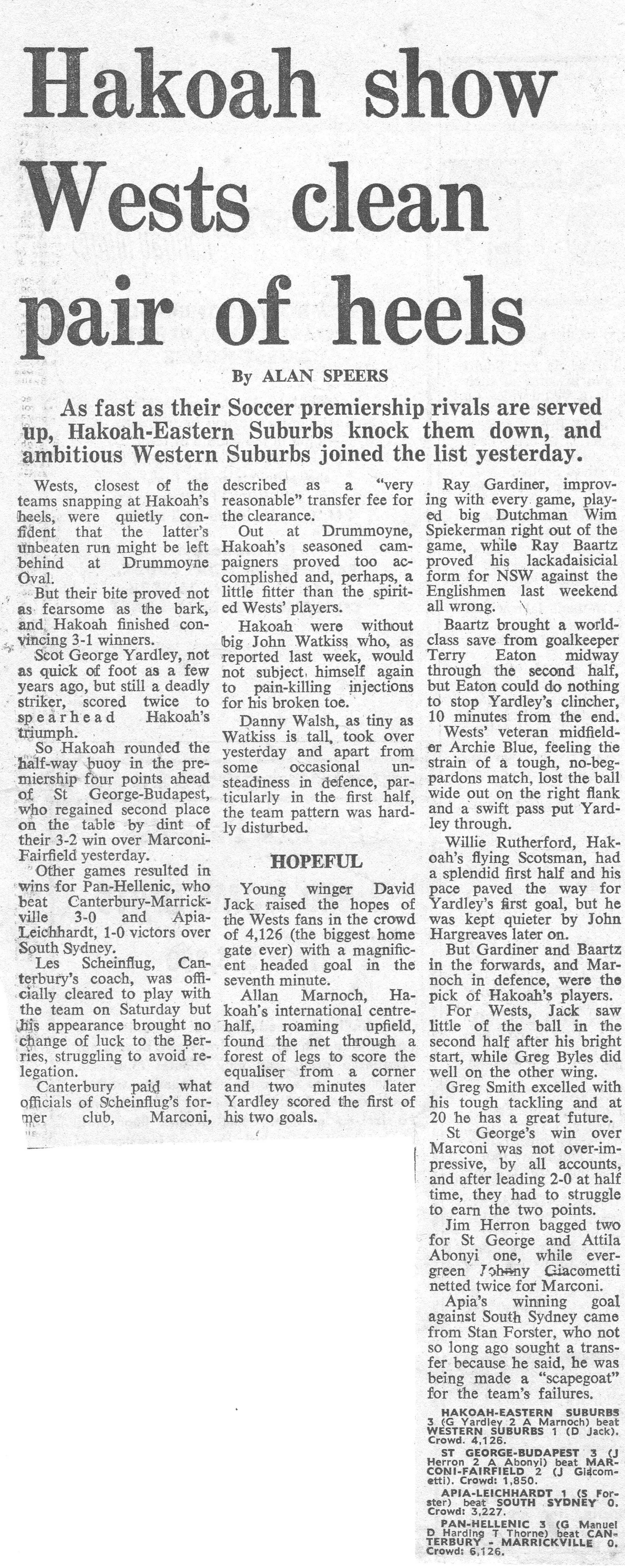
Sydney Morning Herald 7th June 1971
Wests had recruited extensively pre season and boasted three typically tough Scotsman in captain Archie Blue, George Kinnell and Davey Johnston. They had also signed Brian Turner who had returned from a stint as an apprentice professional with Tottenham Hotspur, the lanky Wim Spiekerman, the 1969 Golden Boot winner from Wilhelmina in the Victorian Federation and the equally lanky and experienced former APIA defender, Cliff van Blerk. A number of Novocastrians, including Greg Smith and Peter Pont were encouraged to leave behind their Newcastle roots and the gifted Greg Byles and reliable John Hargeaves were just two of the local Sydney youngsters, proving that all that glitters did not have to come from overseas. Western Suburbs also had two representative goalkeepers in their ranks, Ross Kelly having played for Australia and Terry “The Eagle” Eaton for NSW.
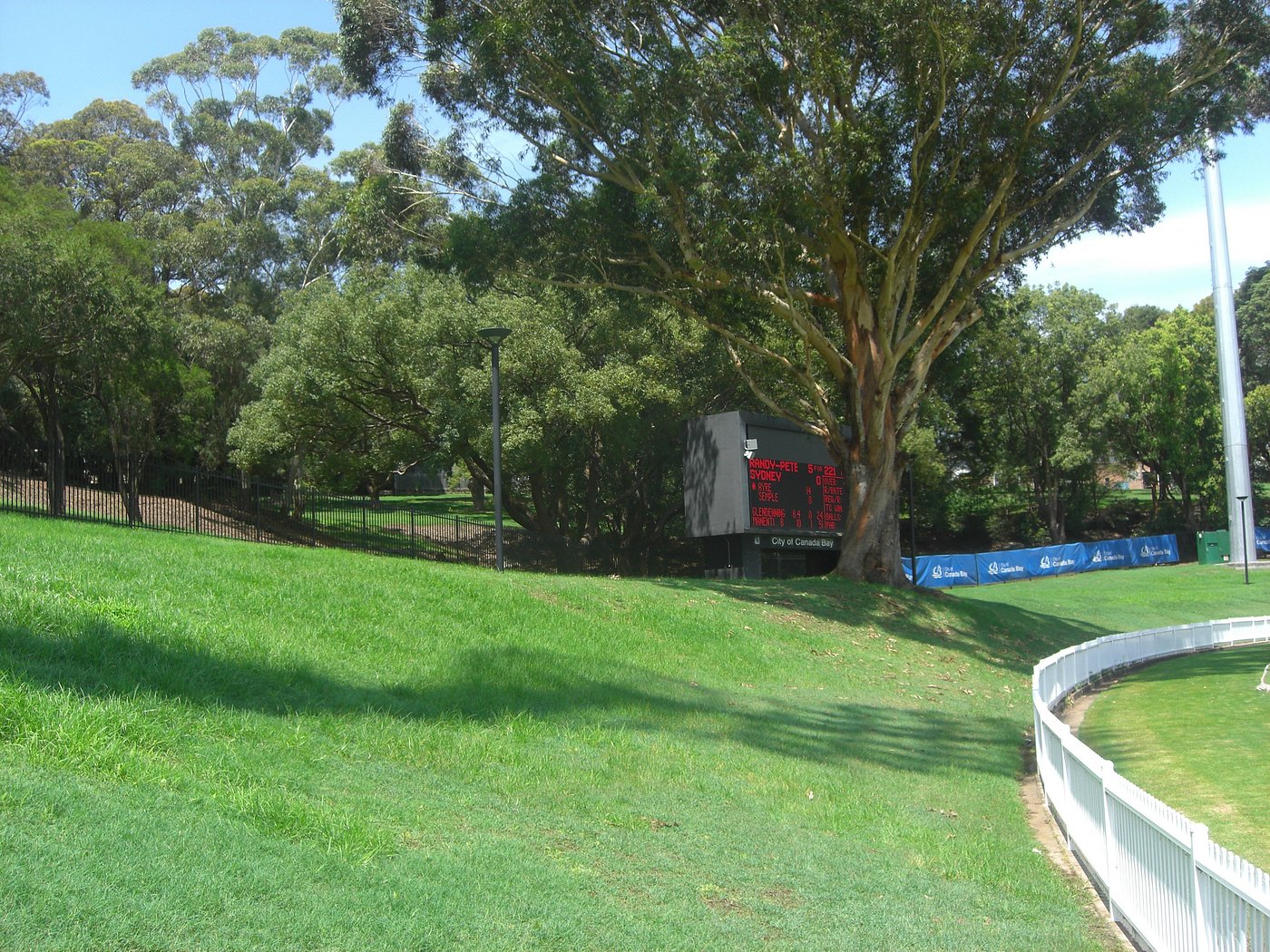
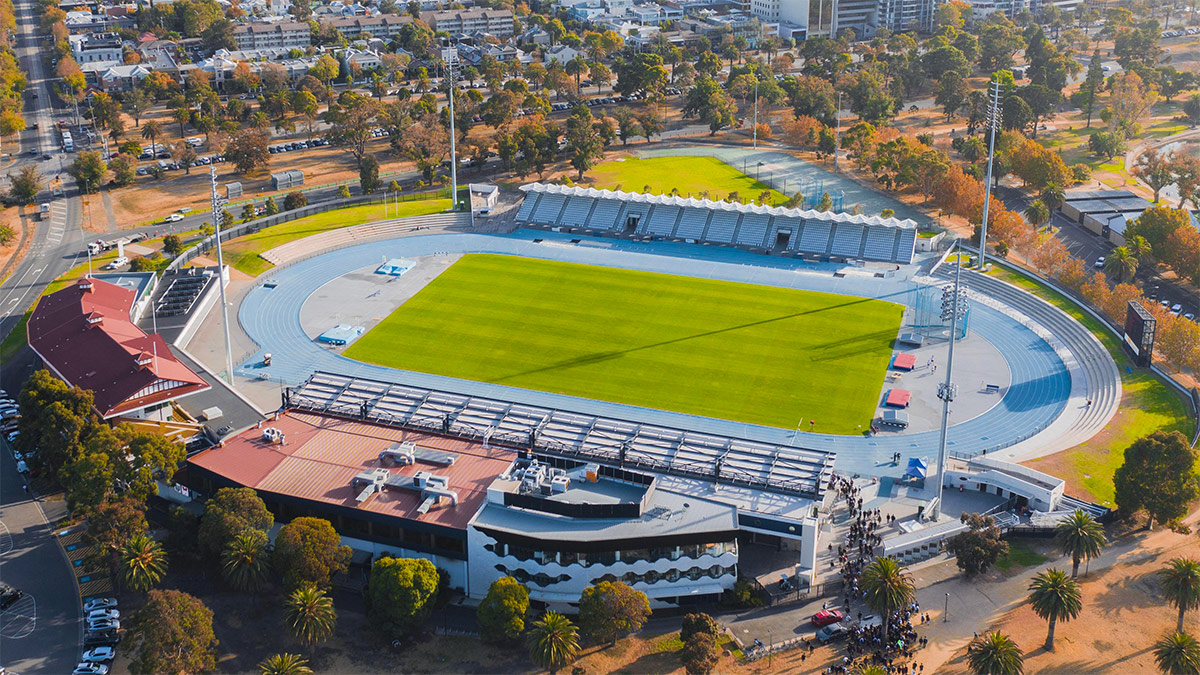
The Drummoyne Oval hill 2026
For a number of years, Hakoah had dominated local club football, spearheaded by Ray Baartz, the best Australian footballer that I have seen and Hakoah showcased the cream of Australian talent. Like Wests, Hakoah boasted their own Scottish contingent, including one time Australian captain Allan Marnoch, goalkeeper Frank Haffey, George Yardley, Ray Gardiner, speedsters, Willie and Harry Rutherford and a young “Jinky” Joe Watson. Aside from the Scots and Baartz, Johnny Watkiss, Dennis Yaager and Danny Walsh were all Australian internationals and there were few local footballers more skilful than their left sided Brazilian forward, Hilton Silva.
As was customary, the Wests players were treated to a pre game scotch fillet at the Five Dock licenced club and I think that coach, Tommy Dawson may have given us some pre game instructions after lunch, but a combination of Tommy’s mumbling delivery and his Geordie brogue made it difficult to determine whether he was praising the chef for the delicious steak or advising us to close down Ray Baartz and Willie Rutherford as soon as they were in possession.
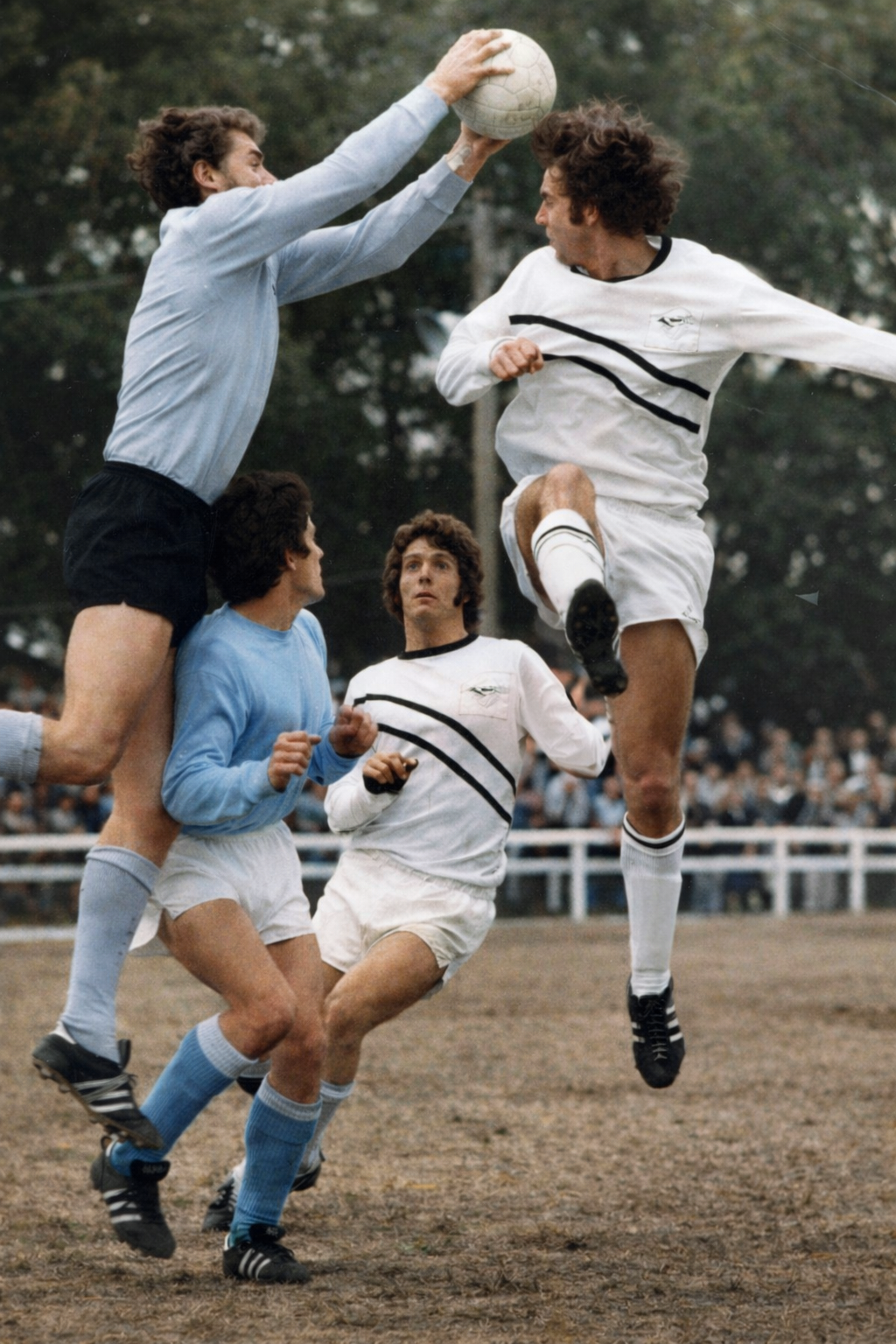
Frank Haffey clutches the ball from Brian Turner’s head
Those who remember Drummoyne Oval in 1971, will tell of a hard, uncompromising surface, bereft of grass, once winter had arrived. This was not unexpected when rugby union and soccer shared training and competition matches on the pitch seven days weekly, with school sports also active daytime during the week. As was customary in 1971, many NSW Soccer Federation grounds “featured” cricket pitches on which bounces could be extremely common and injuries equally so.
Apart from Drummoyne Oval, other grounds including North Sydney Oval, Hurstville Oval and Mona Park with their concrete cricket squares, provided a huge challenge and risk, to footballers in 1971. To think that the modern footballer complains about the Sydney (Allianz) Football Stadium and the unsatisfactory drainage !!
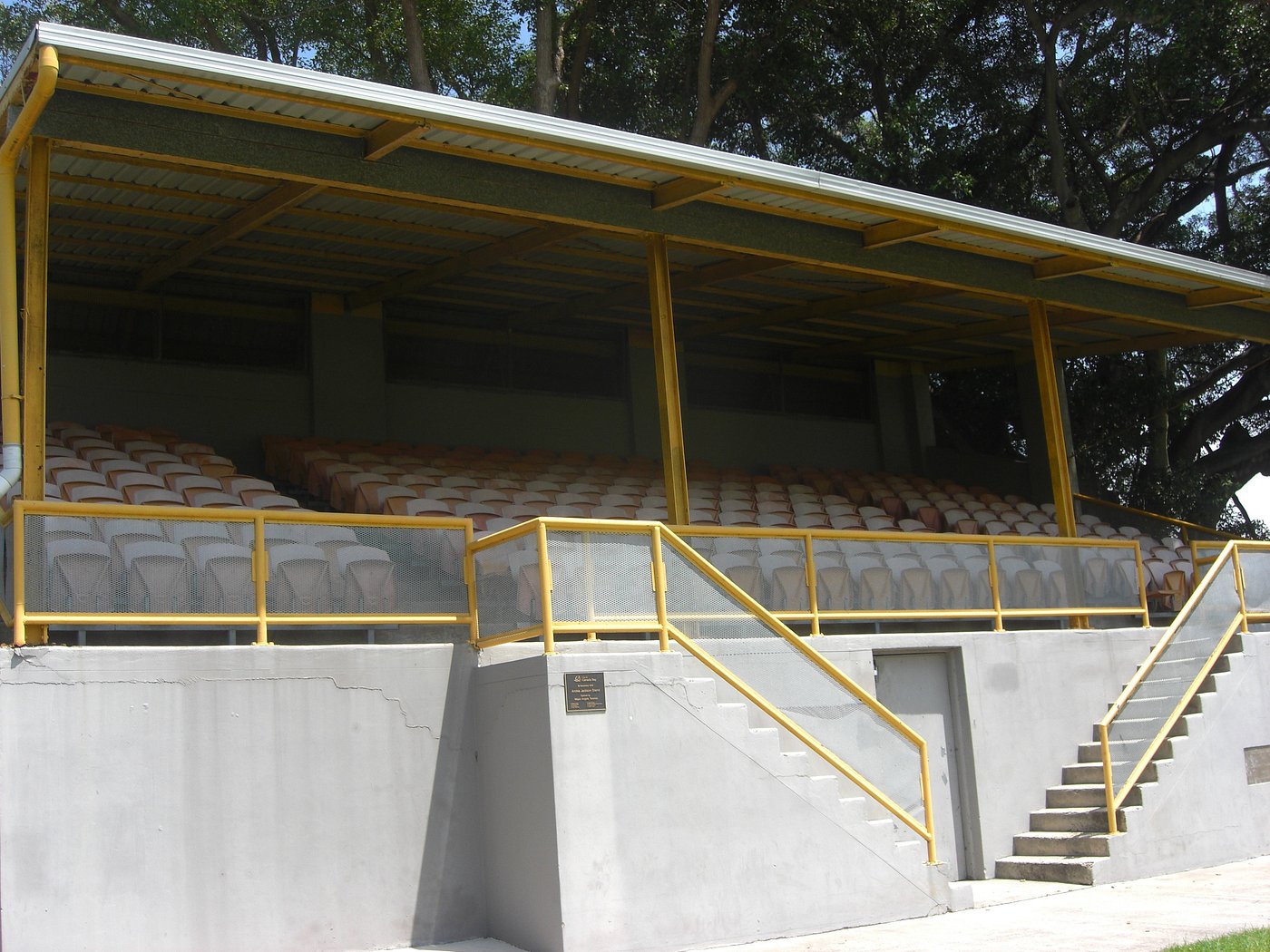
With so many quality players among the sides, it was not surprising that a record home crowd was in attendance at Drummoyne Oval that Sunday afternoon. Although Wests and Hakoah were two of the lesser supported clubs in the first division, over 4,000 spectators attended, most sitting on the grassy hills with the miniature grandstand having been filled in record time.
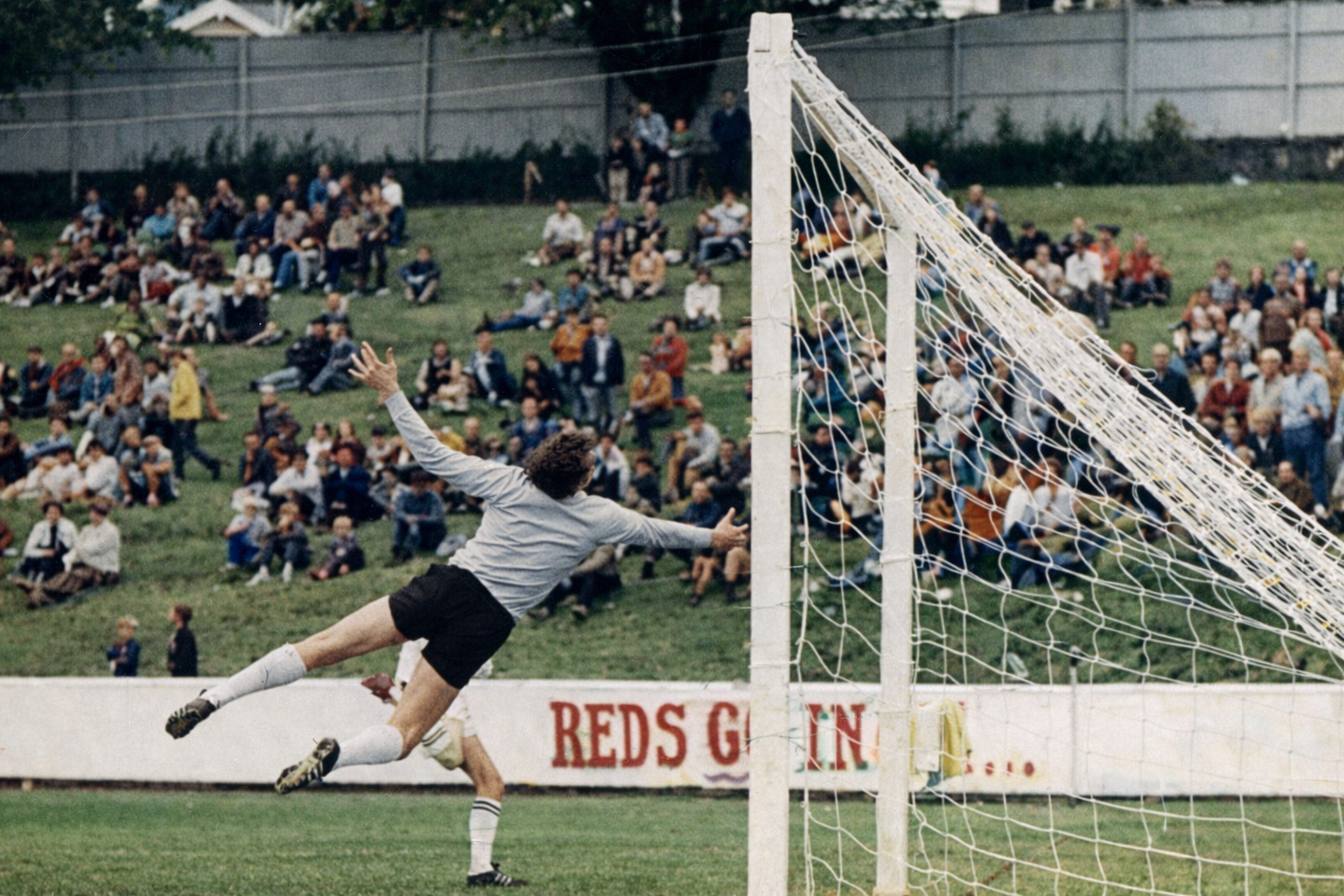
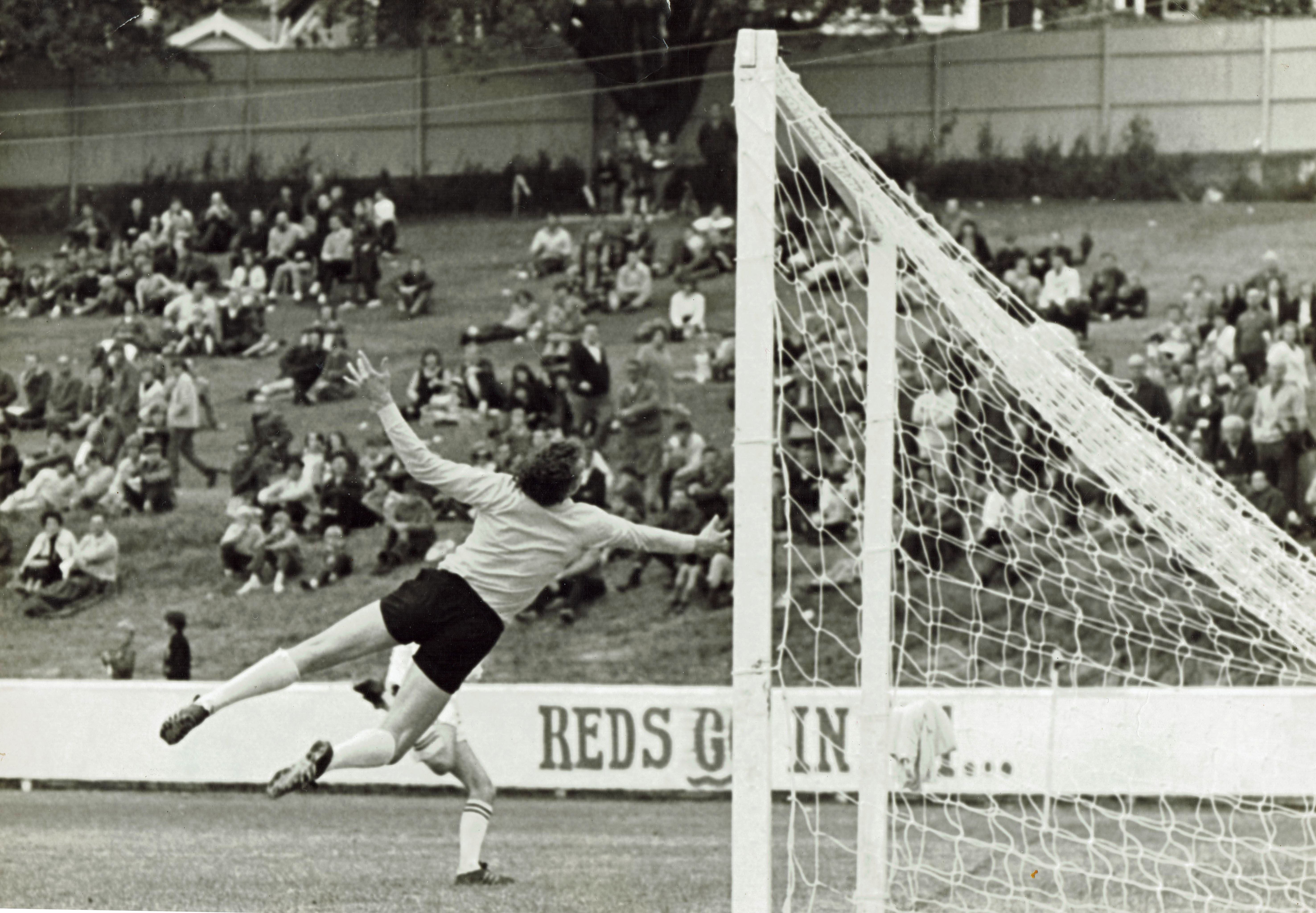
My header after 7 minutes leaves Frank Haffey grasping at air
Pre game, the tight Wests’ dressing room was no place for the claustrophobic. As players vied for five minutes on the massage table, an overriding scent of Dencorub dominated the packed space. This was blended with Marlboro cigarette aroma from the sides’ elder statesman, George Kinnell (no concerns for occupational health and safety in 1971). Kinnell, the former Stoke City and Sunderland professional and second cousin of the legendary Scot, Jim Baxter, was also supplied with a dram of Johnny Walker, pre game and at half time as part of his contractual arrangement.
The affable Dutchman Wim Spiekerman’s left foot shoots for goal
We started brightly and after seven minutes I headed Wests’ first goal past the still agile 32 year old Frank Haffey. Sydney Morning Herald reporter Alan Speers, described my header as “magnificent” so I’m not going to argue with Alan’s assessment! Wests lead was short lived though, with defender Allan Marnoch, an infrequent goalscorer, driving a right foot shot past the veteran Terry Eaton in the Wests’ goal, before the lethal George Yardley put Hakoah, 2-1 into the lead. Hakoah scored a third goal, again through Yardley and although Western Suburbs’ display had shown that they were genuine title contenders, on the day Hakoah had too much class for the Magpies.
The grandstand at Drummoyne Oval circa 2026 – capacity 56 ??
Surprisingly, that season Hakoah were knocked out in the semi final play offs and Western Suburbs went on to reach the NSW Federation Division 1 grand final. We lost that match 2-3 in a tight encounter with St. George Budapest, another Sydney based club with a wealth of footballing talent at that time.
On 6th June 1971, I was extremely lucky to have played with and against so many Australian football greats. Without advocating cricket grounds for football matches, it is a pity that local fans aren’t able to travel to nearby grounds, such as Drummoyne Oval or Hurstville Oval, as in 1971, to watch the cream of local football talent at close quarters.
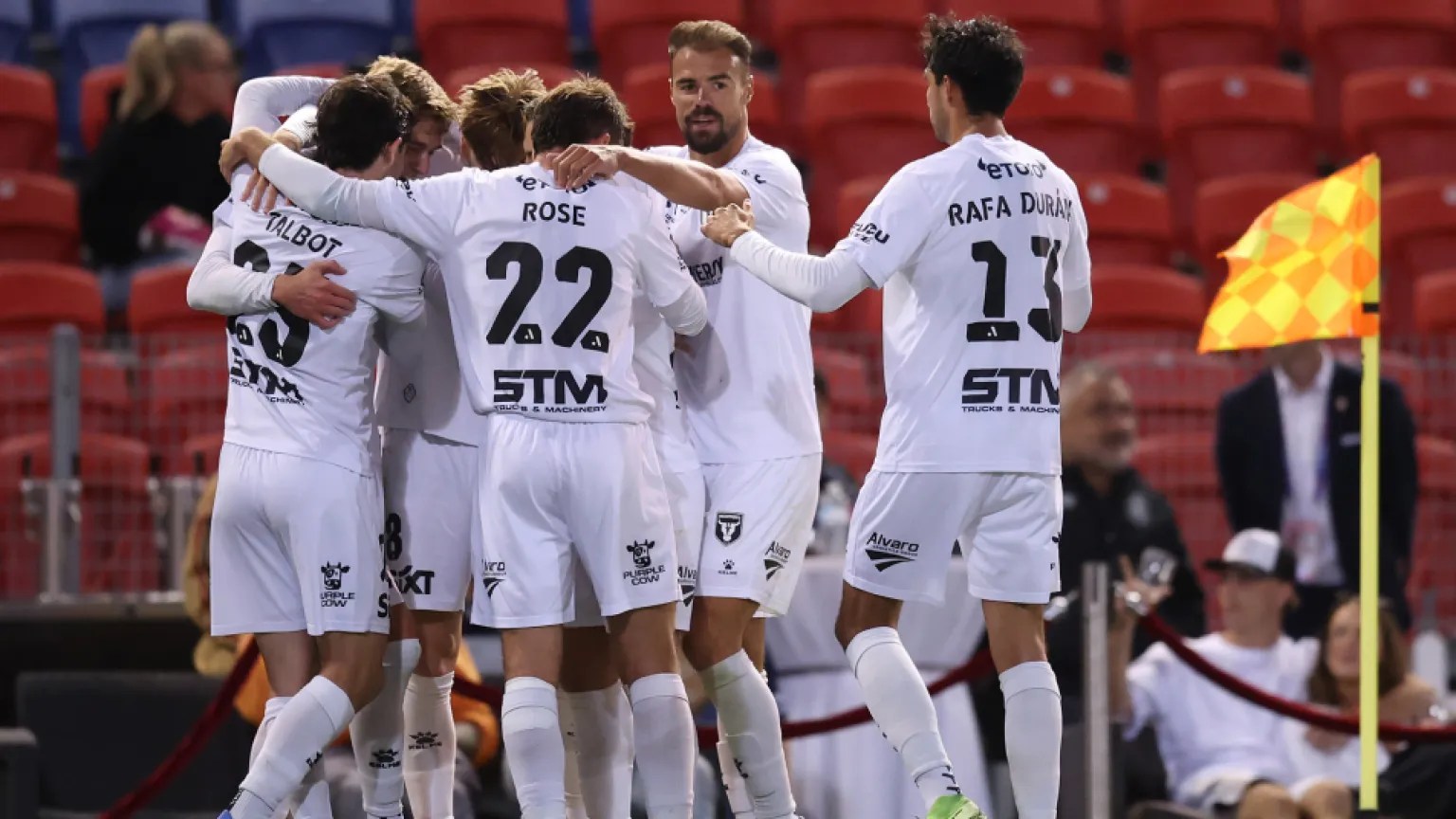
Macarthur Bulls players celebrate another goal against Newcastle Jets in their 5-4 win. Sadly, a minimal crowd
There are very good reasons why association football / soccer is the most popular sport on Earth. To play at the elite level requires an enormous amount of skill and athleticism but the beauty of football is that you don’t need to have the skill or athleticism of a professional footballer to compete and enjoy the game. The number of people playing different forms of the game has increased exponentially over the last twenty five years. This is due largely to a massive growth in female participants, expanding older age competitions and even grandfathers and grandmothers can get involved with walking football.
“Experienced” footballers enjoying the rigours of walking football
With an extraordinary number of football participants, why then does Australia not have thriving adult professional competitions, playing before packed crowds and why does our football rank well below Rugby League and Australian Rules football (“AFL”) in crowd numbers and media coverage ? There is nothing wrong with the product and excitement that our game can generate – consider the recent 5-4 victory by Macarthur Bulls over Newcastle Jets with the Macarthur winner being scored in the 6th minute of injury time. We still however need to have financially viable clubs consistently attracting crowds to their grounds supported by significant numbers of TV viewers.
Steve Rosich APL Chief Executive – A big job ahead
I believe that our football brand (and we can call it “soccer” if we like) can become the number one spectator sport in the country but a major rethink of local club football is essential. We know that football is the largest participation sport in the country but 98% of participants, myself included, do not attend professional or semi professional football matches. Crowds and interest in the Isuzu A League and Ninja W League are floundering with management of the Australian Professional Leagues (“APL”) recently having passed to a new CEO, Steve Rosich, a person with no previous experience in our football.
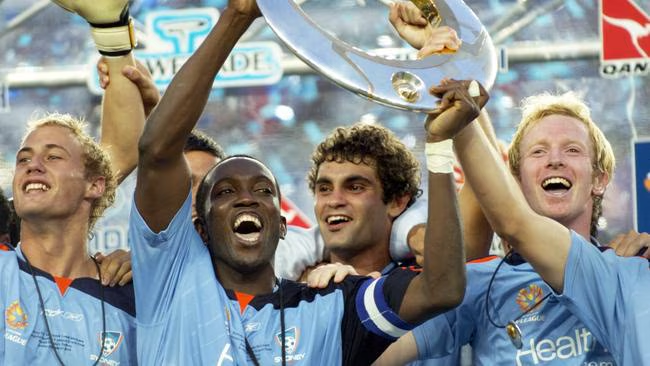
Dwight Yorke celebrates Sydney FC’s A League trophy win 2006
There have been a numerous false dawns in Australian club soccer. We’ve had the impact of mass European immigration after World War 11, qualification for our first FIFA World Cup in 1974, the inception of a National Soccer League in 1977 and then the birth of the A League in 2004. After a promising start boosted by marquee players, the A League and W League are struggling to engender media interest and crowds are declining.
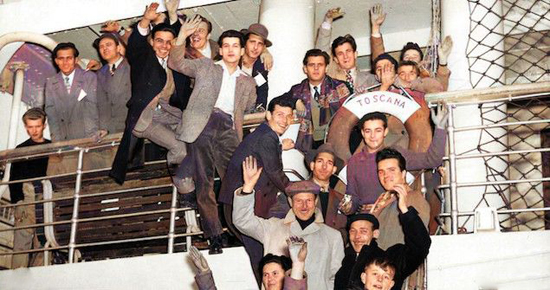
More potential APIA Leichhardt fans disembark in Sydney in 1958
Australian club football needs yet another reset and it is time to wind up the franchise model of former Football Australia chairman Frank Lowy and welcome back to the football fold, the “foundation” clubs and those district clubs nationwide, who are the primary source of football talent in this country.
We need senior competitions where clubs from all over the country can strive to replicate the exploits of Welsh club Wrexham. Last season, Wrexham gained promotion in the United Kingdom for the third successive season and are now knocking on the door of English Premier League football. Why can’t South Melbourne, APIA Leichhardt or Adelaide City have a similar dream to that of Wrexham? Why can’t the elation that the Wrexham fans enjoyed, be mirrored in Australian club football?
Wrexham players celebrate their promotion in 2025
It all seems too hard for Football Australia who seem hell bent on keeping the status quo of the A-League and W-League franchises. Financially, Football Australia have been struggling, burdened by a significant debt owed by the APL, despite revenues reaching a record high as at April 2025. The governing body has been beset with staffing issues and although former CEO James Johnson resigned as far back as May 2025, a full time replacement CEO has still not been appointed.
I don’t believe that a thriving full time professional national football competition is possible in Australia. There is barely an A League or W League club that is financially buoyant and most clubs are living beyond their means. The Isuzu A-League and Ninja W-League clubs presently rely on (diminishing) television rights, financial investment from dubious corporate entities and allocations from grass roots football registration fees to finance their operations.
Manny Aguek scores for Sth. Melbourne v Marconi – Aust. Championship
It will be considered radical and regressive but Australian club football must revert to State based competitions and some players will need to be part time professionals. The recently completed Australian Championship showcased a number of NPL and foundation clubs and considering the less than convenient match scheduling and minimal media coverage, the competition was successful, on and off the park. Under my model, the championship format could be retained with the top two clubs from each State based competition competing for the end of season Australian Championship.
A healthy crowd at Drummoyne Oval – NSW Fed. 1971
Australian club football has to return to making district and community based clubs the focus of club football. Clubs must have their own grounds, which can be modest initially but grounds that become synonymous with the club rather than largely empty, soulless stadia. Those who have witnessed club football in days gone by at Lambert Park, Leichhardt or Lakeside Stadium (formerly Middle Park) Melbourne, remember how even a modest crowd could generate an electric atmosphere. These district and community based clubs must have the ability to play in the highest level of Australian club football.
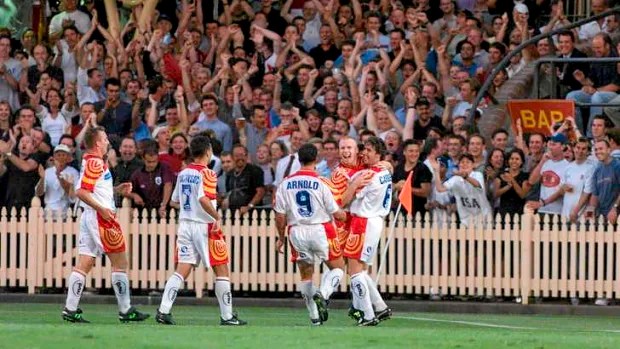
Short lived euphoria for Northern Spirit fans – NSL 1999
Playing State based competitions would have numerous financial benefits. Among these are the significant travel and accommodation cost reduction, increased crowd revenue generated by both sets of fans being able to travel regularly to home and away games and the lower staging expense if clubs were operating out of their own, more modest stadia. Community based clubs would also generate local interest so that young footballers had a clear pathway through the ranks to the top level without being sidetracked by expensive private football academies, whose primary objective is financial. Playing in the club’s home town would create an affiliation, an affection and sense of belonging for local residents, the club would be “our club”.
Lakeside Stadium- home ground of South Melbourne FC
Promotion and relegation from the lowest NPL divisions to the premier level of club football is imperative. No longer would there be meaningless top tier women and men’s football from mid season onwards played in front of empty grandstands. There would be true competition at the top and bottom of all divisions of club football and this would provide all Australian senior players with the opportunity to play at the summit of Australian club football.
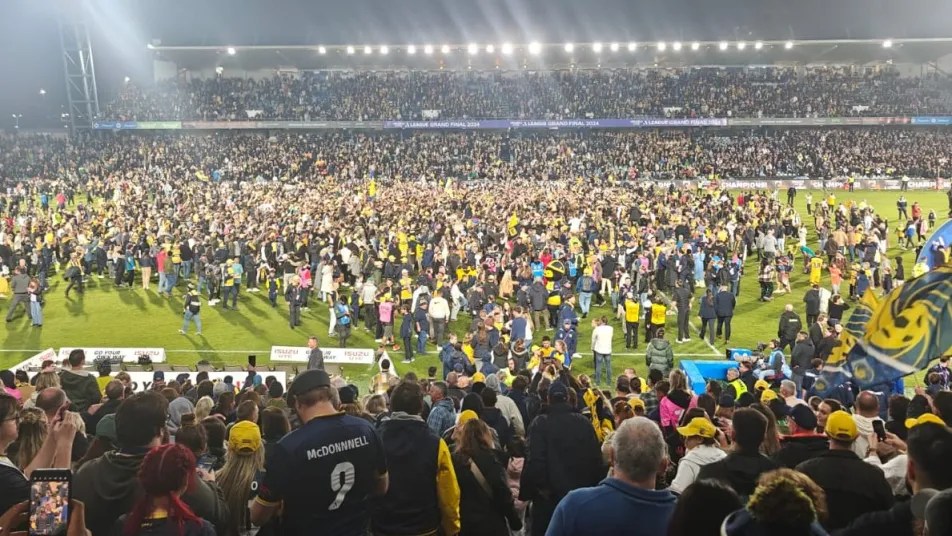
The 2024 Isuzu A League Grand Final, played at Industree Group Stadium Gosford perfectly showed that the future of Australian club football lies not with centralised clubs playing in large sparsely populated stadia, Allianz Stadium Sydney and Suncorp Stadium Brisbane come to mind, but in smaller local grounds centred in the heartland of the clubs’ supporter base.
Jubilant CC Mariners fans celebrate their 2024 Grand Final victory
Admittedly, this was a grand final, but the Mariners “rags to riches” success captivated the district. This was the locals’ own team performing above expectation in their club’s backyard. Club supporters don’t want to have to battle city traffic or parking issues to watch their local team. The Manly Sea Eagles rugby league fans are a good example where the fans will rarely travel outside of what they call “God’s country” to support their team. However, give the Manly fans “Brookie Oval”, now 4 Pines Park on a Friday or Saturday night and the ground will be packed.
Frank Lowy wanted football to become the primary football code in Australia but as Lowy’s grandiose plans for the A – League and W League have wilted and with crowds and interest diminishing, it is time for yet another reset of Australian club football. Premier level competitions where clubs are clearly aligned with a community and /or geographical location, playing at their appropriately sized and situated grounds, in front of excited, vibrant crowds.
As I sit here at midnight on a February evening in the stifling heat and humidity of suburban Sydney, I feel most uncomfortable. Sweat is dripping off my brow and the last thing I would want to do at the moment, is chase a ball around a football pitch. If however I was an A League or W League professional footballer, this would be my lot for the greater part of my football season and not in the comparative cool of midnight.
Back in 1984, crowds attending the Australian National Soccer League (NSL) were on the decline. Desperate times called for desperate measures. When the switch from playing football in winter to the warmer summer months was mooted that same year, then NSL General Manager, Stefan Kamasz, stated that the push to change to a summer season (which didn’t materialise until 1989), related entirely to the diminishing NSL crowds. The proposed switch to a summer soccer season was completely driven by negativity – a fear of competition from the other football variants.
When is hot too hot ?
Another A League victim of the Australian heat
During an SBS televised debate in 1984, Eddie Thompson, the former Australian national team coach said that playing in summer, would mean that soccer would only have to compete with cricket for spectators and media coverage. Thompson also said that “cricket was not everybody’s cup of tea,” although I would have expected no less a comment from a Scotsman.
No longer does soccer have competition solely from cricket and a couple of tennis tournaments. Without leaving our living rooms, we can now watch a range of sports from all around the world, including cricket’s Big Bash League, baseball, NBA, UFC and various forms of racing. When newspaper coverage of National Rugby League and Australian Rules Football can exceed four pages in their non playing months of November, December and January, the battle for print media exposure is still clearly evident.
The 1984 Summer Soccer think tank – SBS Television
Now in 2019, attendances at our national league matches are again on a worrying downward slide and TV viewing audiences are not holding up any better. Eddie Cochran in 1958 sang that “there ain’t no cure for the summertime blues.” As far as our current attendance blues are concerned, my partial cure would be to revert to playing our football primarily in the winter months, a far more favourable climate for the world game.
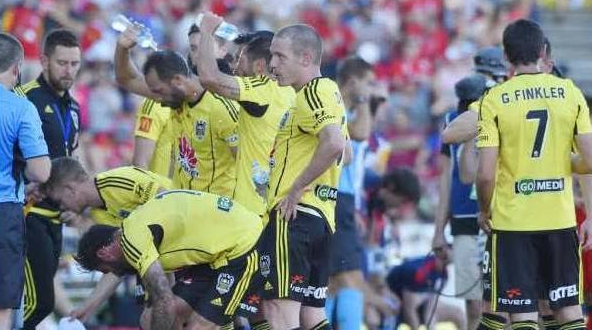
Playing Australia’s foremost men’s and women’s football competitions, the A League and W League in the summer months when heat and humidity will sap the energy of even the fittest of professional players, does not make sense. U.S. WW2 General George Patten said “fatigue makes cowards of us all” and there is no doubt that the often oppressive conditions in summer, detract from the player’s energy and performance. Players make elementary errors simply due to fatigue. To improve crowds, we need to provide a better product that will thrill and excite the crowds. Playing matches in excessive heat will not increase the speed nor intensity of the games, basic skill levels drop and consequently the match as a spectacle will suffer. The essential drink’s breaks in extreme conditions also creates an unwelcome disruption to the traditional flow of the game.
American tennis player Jack Sock suffering from extreme heat stress
The original intention with summer soccer was for all games to be played in the evenings when it was expected that the temperatures would be more moderate. This has not been the case however, with late afternoon kick offs commonplace and the Women’s League starting even earlier. A recent A League fixture between Adelaide United and Brisbane Roar kicked off at 7.30 p.m. and yet the temperature was still thirty one degrees Celsius. Global warming is a fact that we cannot ignore. In NSW in January 2019, average day and night time temperatures in thirty two centres, were the highest ever recorded. If we continue to play professional football matches in the increasingly hot Australian summers, the health risks for our players could be dire.
The summer soccer protagonists claimed that football fans wouldn’t want to go out at night in the winter months. The Australian winter in the major cities /football centres is not harsh, in fact it is quite mild during most months other than July and August. Football spectators in the colder climates in Europe have coped successfully with winter seasons for over 100 years and if local fans have to wear a coat and scarf to go out and watch a football match, that should not deter them.
Brisbane Roar take time out in the sweltering Adelaide heat
Former NSL General Manager, Stefan Kamasz and many proponents of a summer soccer season also contended that the game was competing for spectators with itself in winter. The thinking was that grassroots players – men, women and children would not be playing in the summer, and would therefore be able to attend the senior professional competition games. This is true to an extent, however I would suggest that when the youngsters themselves are in season and playing in the morning or early afternoon, they would be more likely to be in the mood to attend an A League or W League game. When temperatures exceed thirty degrees Celsius in summer and the children’s football boots are gathering dust in the bottom of their wardrobe, I would say that the beach or a swimming pool would be theirs and their parent’s first consideration.
The availability of grounds from March to November should not be insurmountable with the current push towards “boutique”/ smaller grounds. If rugby and AFL competition at the major venues was an issue, there would be a number of smaller suburban stadia that could accommodate crowds of 15,000 – 20,000 people. Australian soccer cannot presently command crowds of 30,000 spectators consistently, so large capacity arenas are not necessary at the moment.
Not quite the Australian winter
Our “winter” football season should extend from early March to mid November with no break. This would align us with the seasons of our Asian Football Confederation colleagues and would provide for an off season of around three and a half months, far more practical than the current five month layoff. The popular Football Federation Australia (FFA) Cup could take place during the season with the final taking place at season’s end. Currently the timing of the FFA Cup finale is anticlimactic, taking place very early in the A League season. Both National Premier League (NPL) and A League clubs would then have equitable preparation for the cup competition, unlike the present situation.Also, any Australian club progressing to the latter stages of the Asian Champions League would not be disadvantaged, by playing an Asian opponent, when they are out of season. Furthermore, overseas teams visiting Australia on their fundraising, replica shirt selling, “An Evening with Joe Bloggs” junkets, could expect sterner competition from season hardened local opponents, rather than a disjointed rabble of match shy players, who clearly would prefer to be at Bondi Beach.
Association football has thrived throughout the world for 140 years. In Australia, it’s time for us to stop worrying about competition, cease consistently looking over our shoulders and take all the steps necessary to focus on advancing our game in this country. It’s time to admit that the summer soccer experiment has not worked. Reverting to a winter football season for our men’s and women’s premier competitions would help raise the the standard and intensity of matches, improve player comfort and safety and bring our national leagues’ season into alignment with the rest of the football community, both in Australia and in Asia.
With the breaking news that the FFA is considering a shortened 2019-20 season to cater for the A League expansion, this would present an ideal opportunity for the launch of winter football for our male and female professional leagues in March 2020. Australian football, as Paul McCartney once sang of Jo Jo, needs to get back to where it once belonged – winter.
On 28th December 1963, on a cold Manchester afternoon, this 10 year old was smuggled (as usual) into the press box at Old Trafford, under my late father’s overcoat. My team Manchester United had been hammered by Burnley 6- 1 a few days earlier, continuing what for them had been an ordinary season. United’s manager, the legendary Matt Busby had made one notable change to the side thrashed a few days earlier, bringing in a slightly built 17 year old Irishman, George Best.
My memories of that game are blurred but I do remember the bright orange colour of the ball, in vogue in those days and that this young boy, George Best scored one of the goals as United exacted 5 -1 revenge on their Lancashire neighbours, Burnely. Best had made his debut earlier in September that year, but his fatherly mentor and manager, Matt Busby decided that George needed a little more toughening in the reserves before he would be let leash on the English first division. Best was never again left out of a United side during Busby’s reign, after that second Burnley match.
George Best holding his left boot after an F.A. Cup tie in 1965
I would subsequently forego the relative comfort of the press box to watch United with my school friends on the Old Trafford terraces. Best reigned supreme at United for 11 years, outshining no such lesser names as Bobby Charlton and Denis Law. Still a youngster, I was not allowed to attend mid week matches, but can remember many a morning waking up after a midweek fixture and asking my dad “How did we go ?”. Very often, the response would be simply “Bestie murdered them”
As a child I dreamed of playing for United and I wanted to be Georgie Best. I wore my shirt out over my shorts like George, I tried to imitate George’s dribbling style and mannerisms and as soon as I was able to shave, I would try to grow the “designer stubble”. My family moved to Australia in March 1967 and I was devastated. How could I live without my United, my idol, Georgie Best?I didn’t have to wait long however, as Manchester United toured Australia in June that year. On a rain soaked Sydney Showground pitch on a Wednesday evening, United put three goals past a Sydney representative side and George Best scored a memorable goal from a short corner. I later played with the man marking George that night, Cliff Van Blerk. Cliff was a lovely fellow but as a full back he could tackle as hard as anyone. Well Cliff fondly recalls that although he played in the NSW Federation (State League) into his 30’s, his struggle with George Best that night took 10 years off his life.
Having had this shot of Manchester United and Best, I carried on my life in Australia progressing through the local football ranks until 1970 when I was offered a trial with Manchester United. Truly a dream come true. I had three months at United and witnessed first hand the character and the footballing brilliance of George Best. I played in the United “B” team and was fortunate to be on the same training pitch and play in small sided games with George.
Once again, George gets the better of Ron “Chopper” Harris
United offered to keep me on for a further twelve months, but I was homesick and decided to return to Australia. Maybe I was still trying to imitate Best, who himself fled Manchester for Belfast, after just acouple of days at United, before later returning. I played many years in the local NSW State League still trying to be George. I tried (successfully) to flick the ball away from a goalkeeper like Best did to Gordon Banks in Belfast. I went through a period of consistently trying the audacious lob that Best pulled off against Spurs at Old Trafford. I gave up shooting with power for a whole season – just lobbed everything. How ridiculous !
I was content to live out my life in Australia and enjoy the childhood memories of a player whose artistry, courage, speed and sheer football brilliance will never be matched. Out of the blue I came across George again in 1983. By now his extravagant lifestyle had contrived to make George, by necessity, a footballing mercenary and he arrived in Australia that year to play for Brisbane Lions in the old National Soccer League. Along with thousands of others, I travelled to Sydney’s Marconi Stadium to see George play. All came with great expectations but George, by then 37 had a quiet match but we didn’t care – he was George Best.
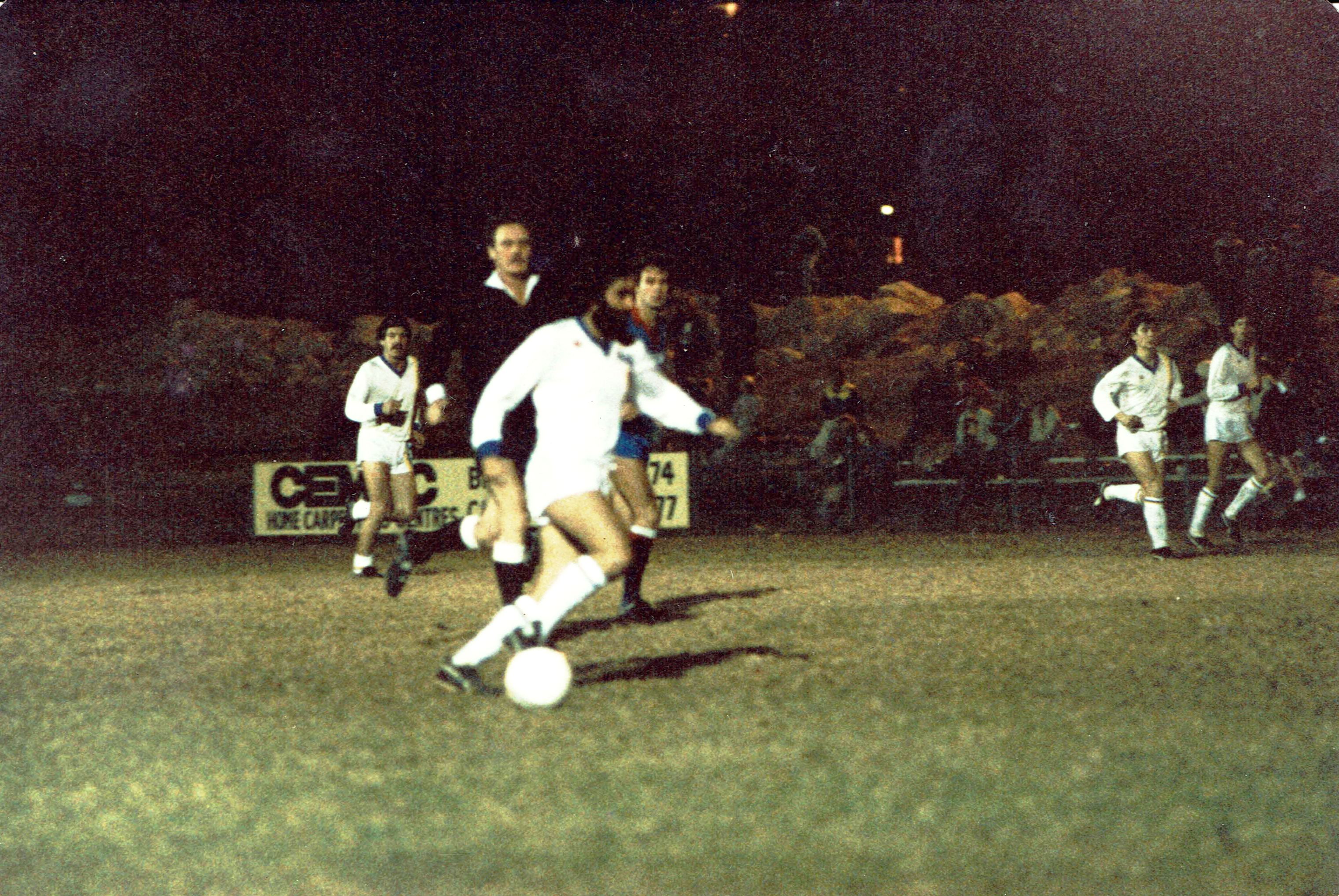
George Best playing for Dee Why against Manly in 1983 – I’m in the blue strip of Manly, shadowing George
When George’s stint with Brisbane came to an end, he stayed on for a short while and amazingly I would again end up on the same pitch as my idol. The Best resume which showed “work experience” ranging from the world’s most famous football club to Dunstable Town, suddenly had a new entry – Dee Why Swans. George, a little short of cash at that time, agreed to play for Dee Why for a reputed sum of AUD5,000. A crowd of several thousand turned up at Cromer Park, Dee Why where my team Manly Warringah were to play Dee Why. George played the full match. He struck the post early in the first half from 35 metres, just to remind the crowd that they were in the presence of a one time superstar. Manly won 3 -2 but George did manage to get on scoresheet. When George scored, nobody cared that he was conservatively 3 metres offside. George rounded our keeper Mark Dower, with the same ease that he did when beating the Benfica goalkeeper, Jose Henrique to score that famous 1968 European Cup Final goal.
The Belfast grave of George and mother Annie
A shy and modest man despite the fame and adulation, George Best was the complete footballer. The adjectives to describe his talent are never ending and only those who saw him at his peak can bear testament to his true greatness. The world of football is an immeasurably better place for his life and was greatly saddened by his premature death.
George Best died in a London hospital on 25th November 2005 from complications resulting from an earlier liver transplant.
George Best – The Belfast Boy, one of the most exciting players to have pulled on a pair of football boots
On this day in 1946, George Best, the son of Dickie and Anne Best was born in a Belfast Hospital. The pointless argument will forever continue as to who is the greatest footballer of all time and for me, George Best is up there with Pele, Maradona, Messi, Cristiano Ronaldo, Di Stefano, Cryuff and others in elite footballing company.
As stated though, it is pointless to nominate the “greatest” because it is not possible to compare players from different eras. As English Premier League pundit Andy Gray once suggested, could (Lionel Messi) “do it on a cold winter’s night at Stoke”. How would Pele have coped on the mud bath at The Baseball Ground home of Derby County and without modern training and sports science, would Cristiano Ronaldo be the almost perfect physically structured footballer that he is? We wonder too, would Maradona have been as effective and had such masterly ball control and touch had he worn 1930’s vintage clodhopper football boots and had to play with a heavy, laced waterlogged leather ball?
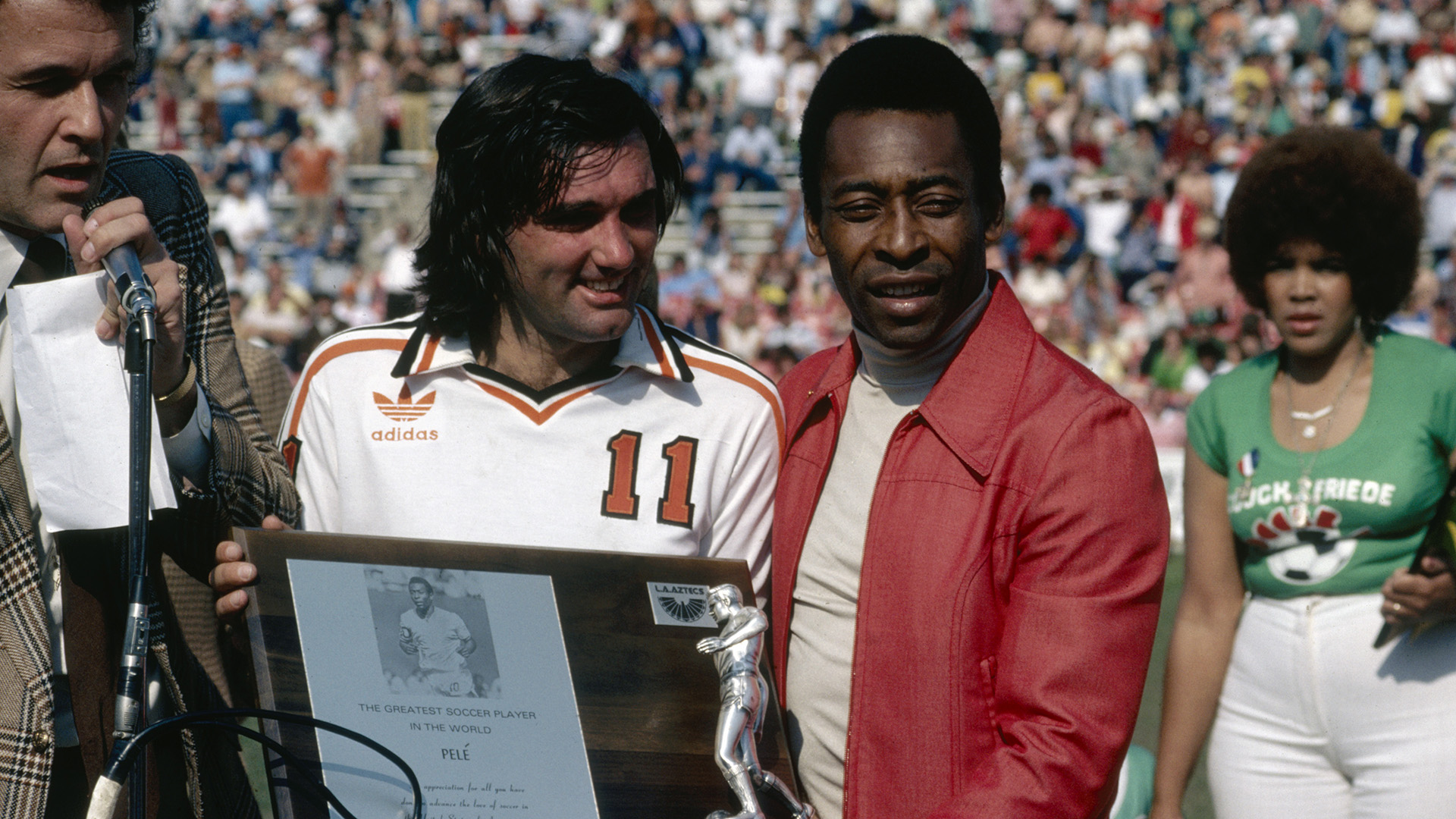
Diego Armando MaradonaLionel Messi / Cristiano RonaldoGeorge Best & Pele in the USA
Between them, Messi and Ronaldo have won numerous Ballon d’Ors, the ultimate individual award for a footballer but they have also been fortunate to have played in club teams, consistently bristling with very talented players. As their success at international level has not matched that of when playing with their club teams, could it be argued that they owe much to their talented clubmates as it is certainly easier for an individual to impress when surrounded by class players? Likewise Alfredo Di Stefano at Real Madrid had an outstanding supporting cast, including the Hungarian “Galloping Major”, Ferenc Puskas. We need to concede that there is no level playing field to rank the numerous great footballers from any period of football history and therefore there will never be consensus.
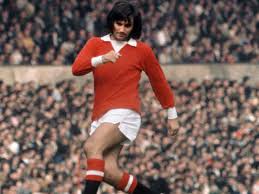
Right ! As I have now established unequivocally that the greatest footballer of all time cannot singularly be determined, who is the player that I would most want to watch if I was down to the last 90 minutes of my life – my last two halves of football on this earth? My choice would be today’s birthday boy, George Best. This opinion is not based solely on the skill factor, although George and all the others mentioned earlier had it in abundance, but measured by the player’s excitement factor, poise, style, audacity and the ability to do the unexpected, in short, entertainment value. George Best was an entertainer, a showman and if you paid your admission and George was on the park, entertainment was guaranteed.
George Best airborne, scoring the second of his three goals against West Ham United at Old Trafford 1971
George’s career took off in 1964 almost simultaneously with that of The Beatles. If you were watching Manchester United at Old Trafford at that time, as soon as Best received the ball, instantly thousands of girls erupted into shrill screams and screeches. In the mid nineteen sixties, this type of behavior was usually reserved for four mop top musicians from down the road at Liverpool and a number of blossoming copycat pop bands. Before the soprano voiced crowd could faint, the slight, dark haired leprechaun in football boots had taken off, often through the Manchester mud, on a mazy run. The Irishman would glide past opponents, skipping over ruthless challenges with the grace and balance of a footballing Rudolf Nureyev. On many an occasion, Best would beat a defender and go through the exercise again, teasing his opponent for having the temerity to try and tackle him.
A study of poise and balance in the late 1960’s
George holding his left boot after the F.A. Cup tie in 1965
Though a modest and shy man off the field, on the football pitch George Best was forever the showman. He once beat an opponent by gently playing a one – two off the back of another defender lying injured on the ground. With time running out in an FA Cup tie for Manchester United against Burnley, George’s boot came off but he continued with one boot, laying on a pass for an equalizer with his stockinged foot and then supplying the pass for the winning goal. All this while playing without his left boot !
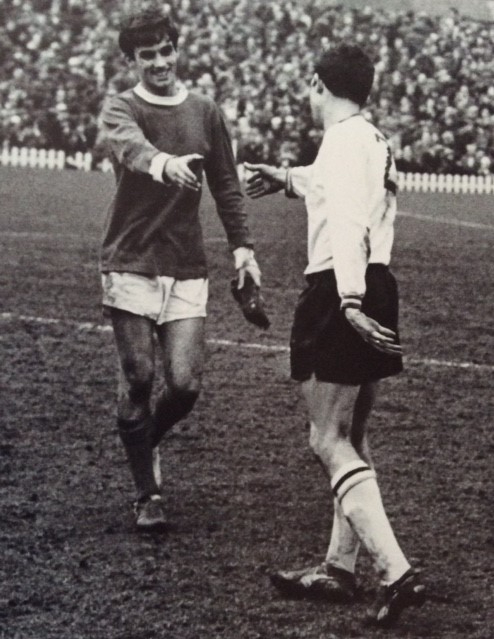
English first division football in the nineteen sixties was a tough gig. Hatchet men such as Chelsea’s Ron (“Chopper”) Harris and Leeds United’s Norman (“Norman Bites Yer Legs”) Hunter took no prisoners and were given more than enough leeway by referees. Best never shirked any challenges and took delight in showing his mastery of the toughest defenders of that time. Though not playing as an out and out striker, the Irishman proved to be not only a great goal scorer (he was Manchester United’s leading marksman for five consecutive seasons) but indeed a scorer of great goals.
Old Trafford October 1970 – Best preparing to dribble around Peter Bonetti to score a wonder goal against Chelsea
George Best saved much of his audacity for goalkeepers. With a flick of George’s slim hips, he would have goalkeepers, clutching at thin air as he shimmied and strolled around them. Shooting for goal would have been the safer, more orthodox option but orthodoxy was not part of the George Best modus operandi. Two of England’s greatest custodians, Peter Bonetti of Chelsea and Gordon Banks of Stoke City were just two to succumb to the Best trickery. Never a dull moment with George.
George’s boldness and torment of goalkeepers peaked in May 1971 playing for Northern Ireland against England at Windsor Park, Belfast. Again, the goalkeeper was Gordon Banks whose kicking technique was to lob the ball with his hand into the air prior to clearing it downfield. Alert to Banks’ method, as the England goalkeeper released the ball, Best nipped in and flicked it goalward away from bemused Banks and then nodded the ball into the net. The “goal” was disallowed most likely because the referee just did not see the incident and to this day Irish supporters claim that they and George Best were robbed of a goal created by the supreme invention of their footballing idol.
Gordon Banks about to be hoodwinked by Best at Windsor Park Belfast in 1971
Banks embarassed again by George Best – Stoke City, Victoria Ground 1971
It is unfortunate that so many of George Best’s goals were not filmed but in 1969 when Manchester United beat Northampton 8-2 in an FA Cup tie, the TV cameras captured all ten goals, with George Best scoring six himself. George completed his double hat trick by dummying around Northampton goalkeeper Kim Book and walking the ball into the empty net as the bemused Book sat in the muddy goalmouth.The pinnacle of George Best’s football career came just six days after his 22nd birthday in the 1968 European Cup Final at Wembley Stadium against Portugal’s Benfica. Blessed with utmost self confidence and seemingly devoid of nerves, with scores level at 1-1 in extra time, a long clearance by Manchester United goalkeeper Alex Stepney was flicked on to Best thirty five metres from the Benfica goal. Instinctively George slotted the ball through a defender’s legs and with only goalkeeper Henrique to beat in the most prestigious match in world club football, rather than drive the ball into the goal, as calm as you like, Best opted to skip around the stranded goalkeeper and stroke the ball into the net. This goal sunk Benfica and United scored twice more to secure their first European title.
One of George Best’s most memorable goals was scored in January 1971 against one of the best British goalkeepers and international team mate of Best, Pat Jennings. Playing against Tottenham Hotspur at Old Trafford, Jennings punched a clearance in the direction of Best who was lurking just inside the crowded penalty area. The Manchester United wizard cushioned the ball on his chest and in one motion lobbed it gently over four Spurs defenders, including Jennings into the net. Goals don’t come much better or more audacious than that.
Upsetting the Merseysiders – taking on Everton George Best shooting against arch rivals, Liverpool
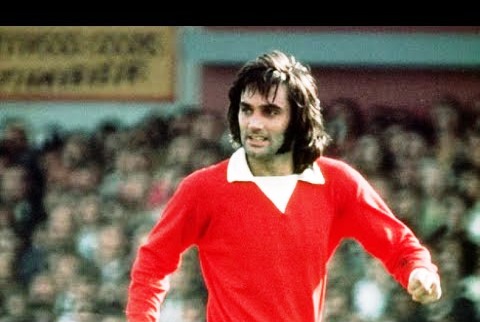
George Best was the complete footballer. He had incredible footballing ability and above all else, cheek. George was not just the player, he was the performer. Much loved throughout the football world, the handsome, quiet Irishman charmed fans as readily as he charmed female company. Ultimately, fame and alcohol brought Best’s illustrious football career and later his life, to a premature end but I will always be grateful that I was able to witness the career of a magical footballer. Is he the best player of all time? Who knows? But as former Manchester City manager Malcom Allison once said “George Best was special – all the others were just footballers.”
“Silent Weekend” in Lancashire, England – what a good idea ! (pic Daily Mail)
My opinion on adult football coaching / managing and the inflated value of such, has been documented previously but the impact of a parent or a coach on the development of young footballers is in need of serious review. We have all witnessed frantic behaviour of parents and coaches on the sidelines of youth football but the “encouragement”, offered by parents and would be English Premier League managers (the team coach) is doing more harm than good to children.
Only last month at Fairfield in Sydney, five adults were charged by NSW Police for affray after a brawl broke out among parents during an Under 7 football match – Let that sink in, an Under 7 game. All parents whose children have played football have hoped that their Jenny or Johnny plays well and scores the winning goal but at times nothing other than confusion or distress can result from pearls of wisdom being screamed from the uneducated on the touchline. By “uneducated” this often extends to the team coach who may have been a parent who assumed the coaching role by default, when other parents shied away from the “opportunity”.
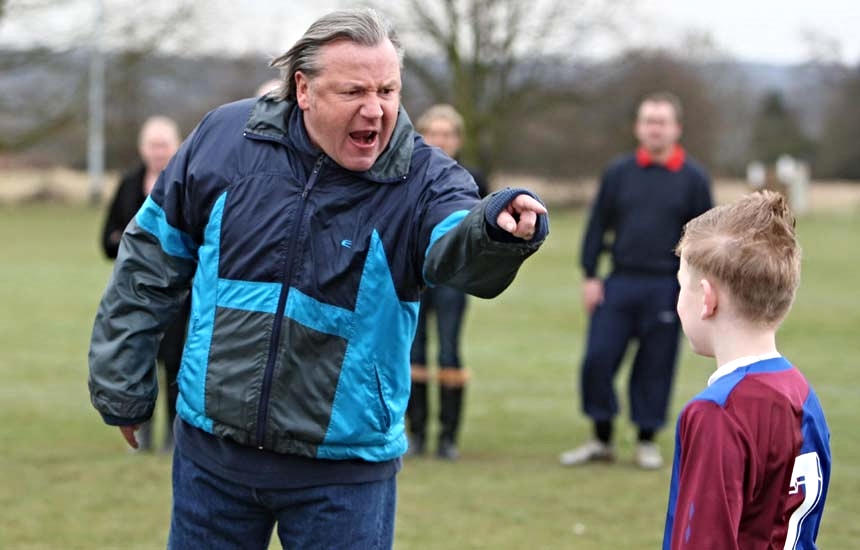
“Can you hear me Johnny ?
Recently, the Lancashire (UK) Football Association designated a “Silent Weekend” with almost 1,000 games played in total touchline silence. The coaches also had to respect the silence directive. “It was an incredible thing,” said Neil Yates, Lancashire County FA welfare officer, whose idea it was. “Gone were the sounds of adults screaming and shouting their advice from the touchline, like a bunch of baying sea lions. It was so refreshing”. The Lancashire Association initiative aims to change the rowdy environment of junior football matches so children have the ability to learn the sport, in a calm and more peaceful environment.
The parents’ responsibility should be to ensure that their children know where and when they are playing on any particular day. The parents then need to make sure that the children are awake in good time, have breakfast, transport is arranged and that the children arrive at the ground, with sufficient time to warm up. That’s it ! By all means, stay and watch the match but other than the occasional “come on Jenny” or “well done Johnny” parents and coaches should keep their mouths shut during the match. Any other comments are distracting, can cause stress for the children and most likely won’t improve their performance.
African children enjoying football in the fields, far from the madding crowd
Thankfully, the existence of competitions for the younger players has been curtailed in recent years, which is a good move helping to modify and improve the behaviour of parents, coaches and players alike. Yes, competitions can allow the young players to bask in the temporary success of winning a medal, but winning a Grand Final does not improve the ability of a young footballer nor their sportsmanship. Certainly, the coach will enjoy adding a string to his bow and the parents can tell all their friends at the next dinner party, but winning medals and trophies is not important in the development of young footballers.
The responsibility of the coach of a young team is to advise the players which position that they should be playing in and in what part of the field they should spend most of their time. The coach must avoid trying to be an expert on the game. Not contribute clichéd coaching expressions such as “keep your shape” “no fouls” (children don’t foul) and don’t tell the six year old that you want him to play as a “6” or an “8” or worse still, as a “number 10 in the hole”. A six year old is not familiar with coaching jargon and will be confused. Explain the child’s position and what you expect from her / him, in plain language.
Helpful ? I don’t think so
I know of examples of coaches sending pages of What’s App messages to 12 year old girls with non sensical information and instructions, well beyond the call of their responsibility as a coach of young footballers. I have heard of coaches wanting young players (and therefore parents) arriving an hour before the scheduled kick off. Young players must enjoy their football experience and such requests and behaviours by the coach do not enhance the player’s match day enjoyment.
The coach must also guarantee that every player receives an even amount of game time. Even if the coach has a potential young Harry Kane or Sam Kerr in their Under 9 side, they should guarantee that young Harry or young Sam spends equal time on the substitute’s bench and if the team does not have a regular goalkeeper, make sure that the goalkeeping load is also shared by all. No favouritism.
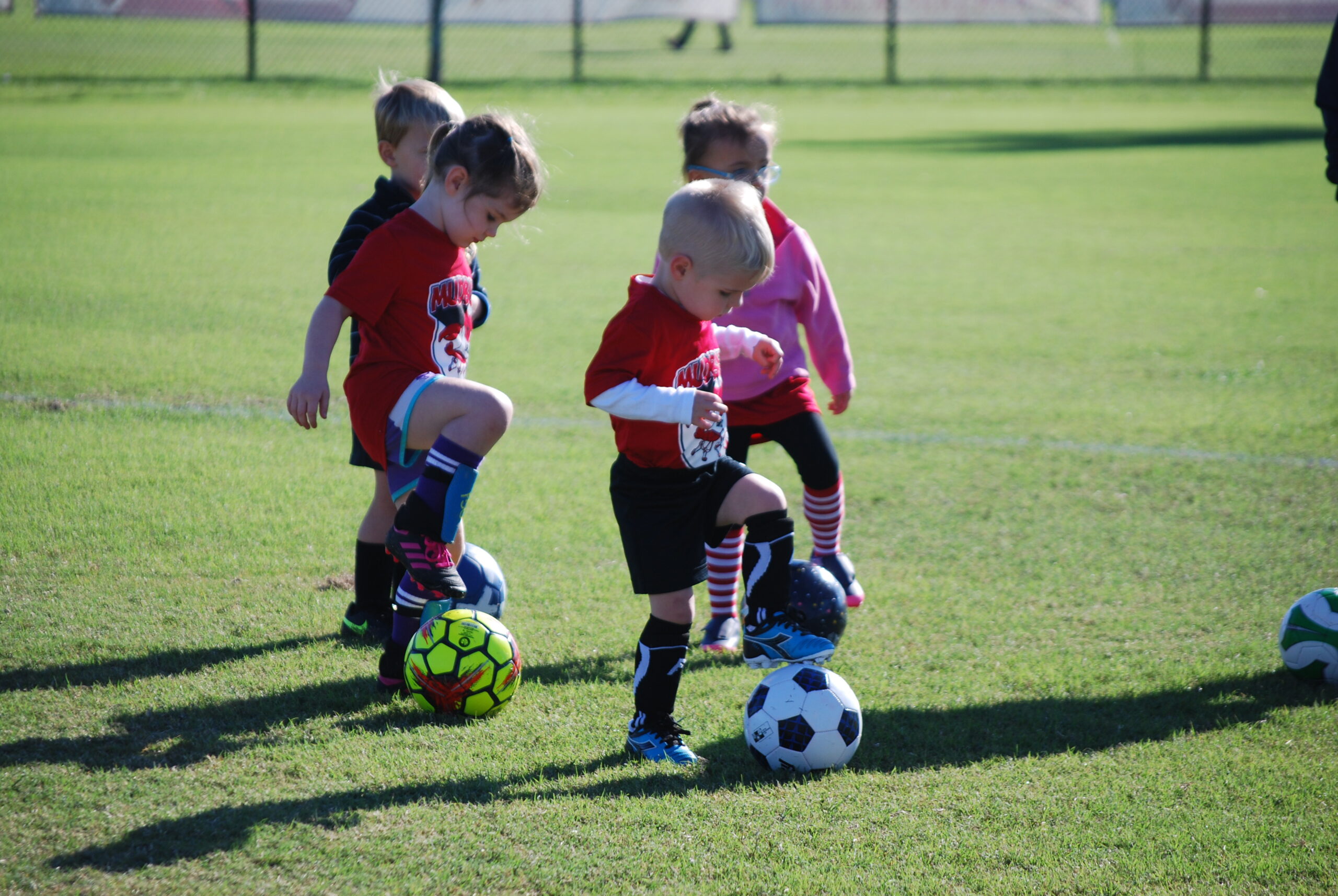
Young footballers learning the basics skills
Australia is not known for having a football culture. Our busy urban environments are not conducive to playing street football and it is no longer safe to play at the park until dark, as I could as a boy. Consequently, young footballers won’t develop their ability naturally and a degree of skills coaching is necessary. The coach of young players should be able to demonstrate the basic skills – passing, trapping, shooting, heading and tackling. A coach should not try to implement systems and tactics for children, at least until they are well into their teens. This would distract them from developing any inherent football ability. As the legendary Liverpool F.C. manager Bill Shankly famously once said, “football is a simple game made complicated by those who should know better.”
Practising the basic skills will provide young Jenny with the ability to competently play the game. At training once these skills have been rehearsed, the coach should allow the team to play as much football as time will allow. On the pitch is the only place that budding footballers will master and improve their ability. This won’t be achieved by running an inordinate number of laps or performing one hundred push ups. The old saying, “necessity is the mother of invention” rings true on the football pitch and this will ensure that young players will develop the ability to dribble past an opponent or improve on all the skills required, without persistent instruction from a coach.
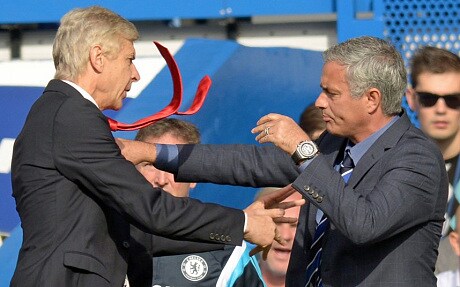
Ego is certainly not a dirty word in the technical areas
The sight of egotistical professional coaches and managers roaming their technical area, bellowing instructions to full time professional footballers is absurd to me. Don’t the players train most days of the week? The players are quite possibly far better exponents of the game than the coach / manager may ever have been. Similarly, the coach of a young team does not need to shout instructions to the team, as it will only confuse and distract them from their game.
If a young footballer is to progress and possibly reach the professional ranks, they need nurturing and encouragement, not ill advised instruction from the touchline brigade. A parent or a coach can assist in the development of a footballer but it is essential that their over zealous actions and words on the sideline don’t hinder the progress of the child. Keep the mouths shut and just let them play.
A young football writer starting out in London in 1947
David Ronald Jack, my father, was born on 6th June 1925 in Bolton, Lancashire. David was the only son of David Bone Nightingale (“DBN”) Jack and Kathleen Jack (nee McCormack). David was a sports writer, author and TV Presenter and he and his wife Rose had seven children. David wrote primarily on Association Football for 40 years, split almost 50/50 between working in England and in Australia. David attended and reported on a number of FIFA World Cup tournaments including milestone achievements of Australia’s first ever World Cup Final’s appearance in 1974 as well as being present at Wembley Stadium on the occasion of England’s World Cup victory in July 1966.
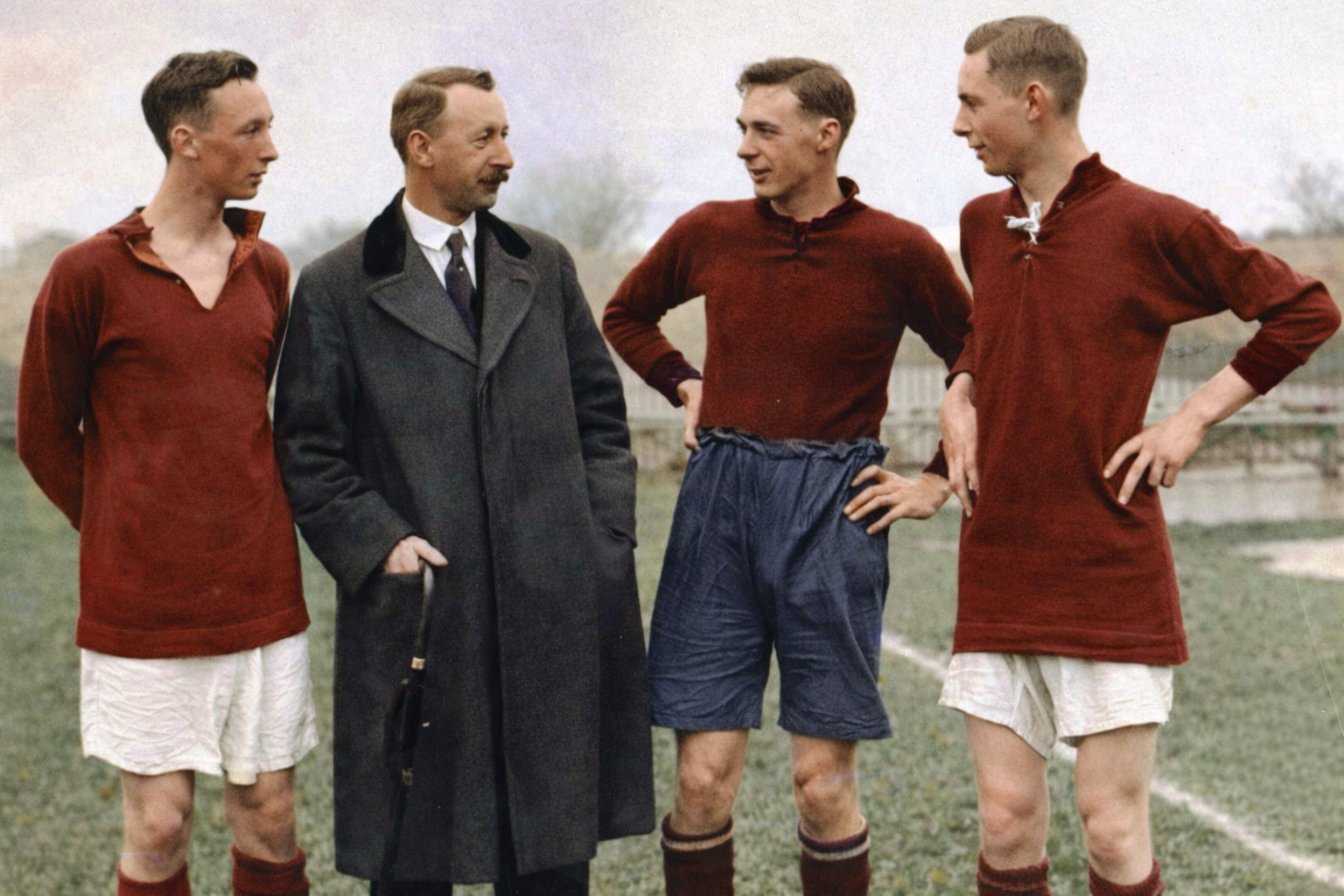
Plymouth ArgyleDonald, Bob, David BN & Rollo Jack
The Jack name had been synonymous with British football for generations. In 1885, David Jack’s grandfather, Bob Jack was amongst the earliest Scottish professional footballers to infiltrate the predominantly amateur game, south of the Scottish border. Bob Jack played professionally for Bolton Wanderers and Preston North End and managed Plymouth Argyle for 29 years. Bob Jack had three sons, Rollo, Donald and David (hereafter referred to as DBN Jack), all professional footballers, although DBN Jack was the stand out.
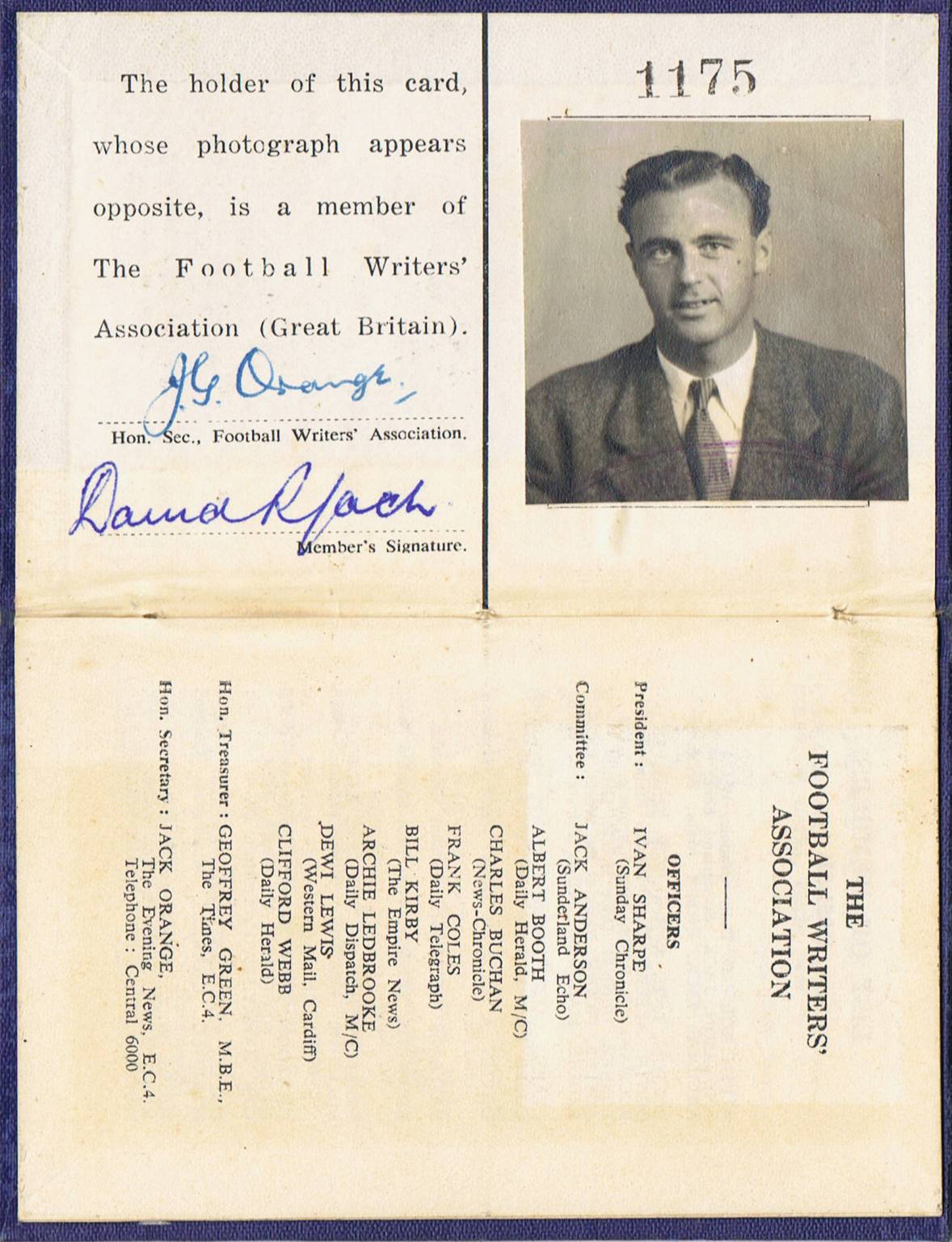
Football Writers Association Membership
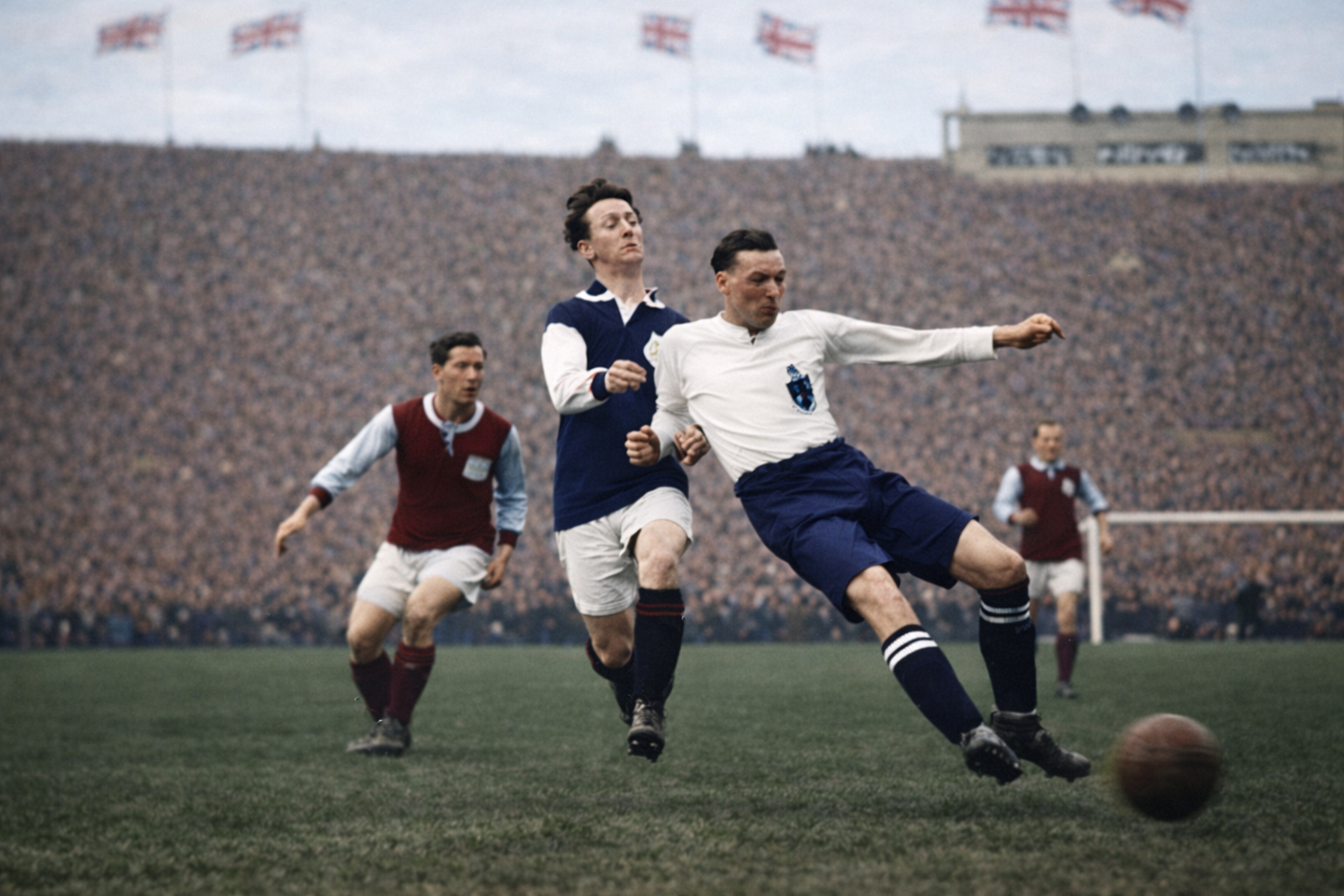
The Jack family excelled in a number of sports, including tennis and Rollo Jack became a high ranking lawn bowls player. DBN Jack scored the first goal in an F.A. Cup Final at Wembley in 1923 and was twice transferred for what were then world record transfer fees. DBN Jack captained England on a number of occasions and his signing by the legendary Arsenal manager, Herbert Chapman in 1928, was the catalyst for almost a decade of continued success for “The Gunners”. DBN Jack scored the only (winning) goal for Bolton Wanderers in the 1926 F.A. Cup Final, just three years after scoring the very first cup final goal at the Empire Stadium, Wembley in 1923.
David B N Jack scoring the first goal at Wembley 1923
Having a father who captained England and two professional footballing uncles, it was inevitable that young David might himself look to earn a living playing football. David was a capable centre half and his father considered that David might make a decent third division centre half but in those days, footballers’ wages were capped and David’s father, an English international, was only earning £8 weekly. Young David was encouraged by his father to get a “proper job” so he joined Barclays Bank. Admittedly, banking wages were no better than those of a third division footballing centre half, however behind the banking counter there was less chance of David sustaining a broken leg or knee cruciate ligament injury, so the prospect of long term employment was more secure.
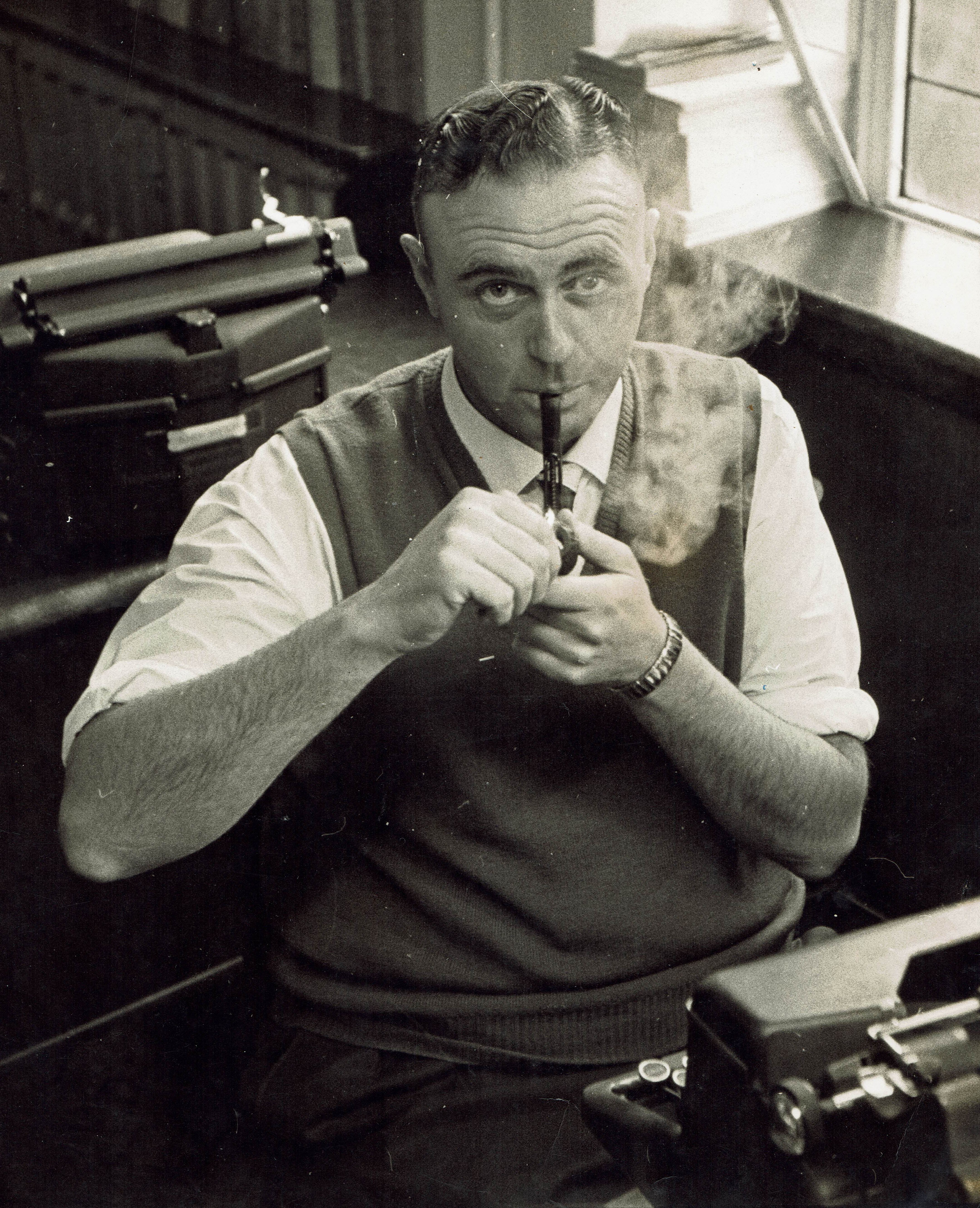
Having a puff in the office in Manchester
Although working as a London bank teller, David’s desire to earn a living from football was strong and in 1947 he applied for and was successful in securing a cadetship in journalism with the Sunday Empire News. Initially restricted to court reporting and mundane stories of garbage bin and cat theft, David’s break in sports journalism came in November 1947. Not yet considered for matches featuring high flying clubs such as Liverpool, Manchester United or Wolverhampton Wanderers, David’s first match report was an intriguing first round F.A. Cup match between non league club Vauxhall Motors and third division Walsall, with the car assembly specialists losing a close encounter 2-1.
In 1947, English football was a seasonal sport and when not engaged in football writing, David covered weightlifting, wrestling, tennis, cricket, speedway and whatever sport entertained post war Great Britain. With the advent of European football championships and England’s belated inclusion in World Cup football, David’s job took him further afield internationally.
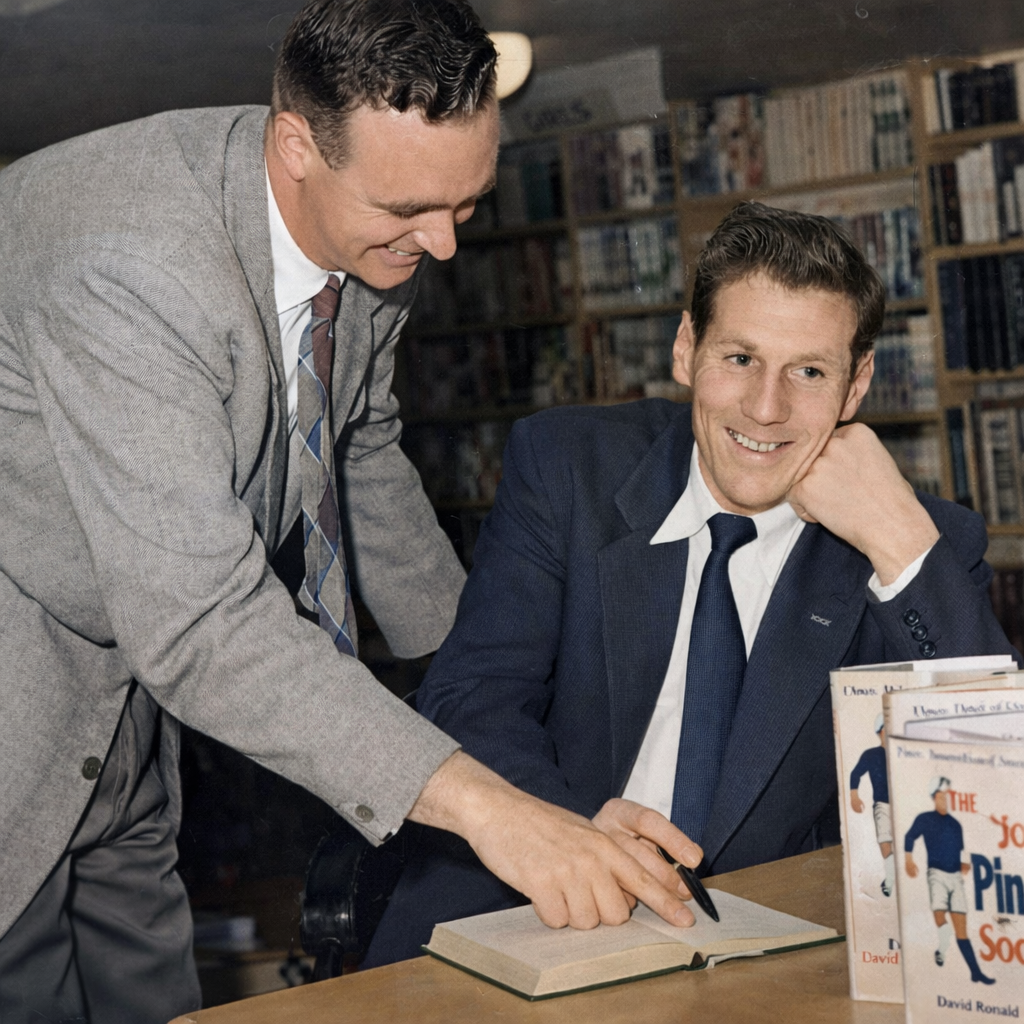
Leaving court reporting behind him and gaining confidence as a writer, David ghosted footballer Len Shackleton’s book “The Clown Prince of Soccer” (Nicholas Kaye Limited 1955). The subject Len Shackleton, was possibly the original “maverick” footballer. A controversial footballer, Shackleton only played a handful of times for England but was famous for his on field party tricks. The book sold well and to this day is still best known for Chapter 9, “The Average Director’s Knowledge of Football” – The chapter was blank.
“Shack” signs a copy of his book for David Jack
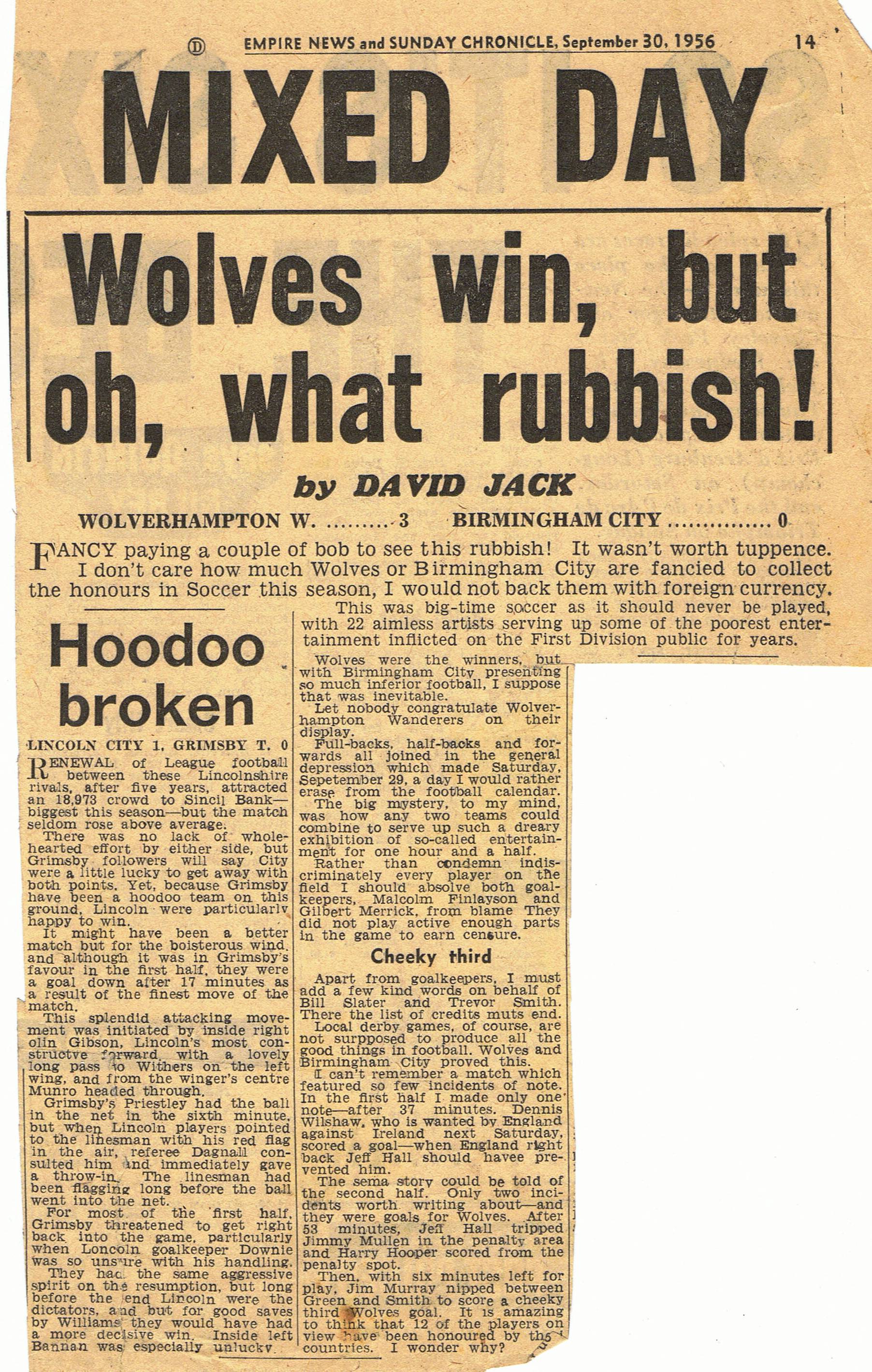
The offending match report
Nearly ten years into his journalism career, David was a reputable and respected football writer. In 1956 however, his reputation risked coming unstuck, the result of a damning but what he considered, honest report of a First Division match between Wolverhampton Wanderers and Birmingham City. Both clubs were unhappy with the report and consequently banned David from press box and directors box facilities at their respective grounds.
In 1957, David ghosted another book, “My Story” (Souvenir Press 1957) Manchester United manager Matt Busby’s autobiography. Although first published in 1957, David revised the book 12 months later, adding another chapter, after the plane crash at Munich the following year, in which eight Manchester United players and eight journalists were killed. Ironically and sadly, the review (below) of “My Story” had been written by the esteemed Manchester based journalist, Donny Davies (“An Old International”) who died in the Munich crash.
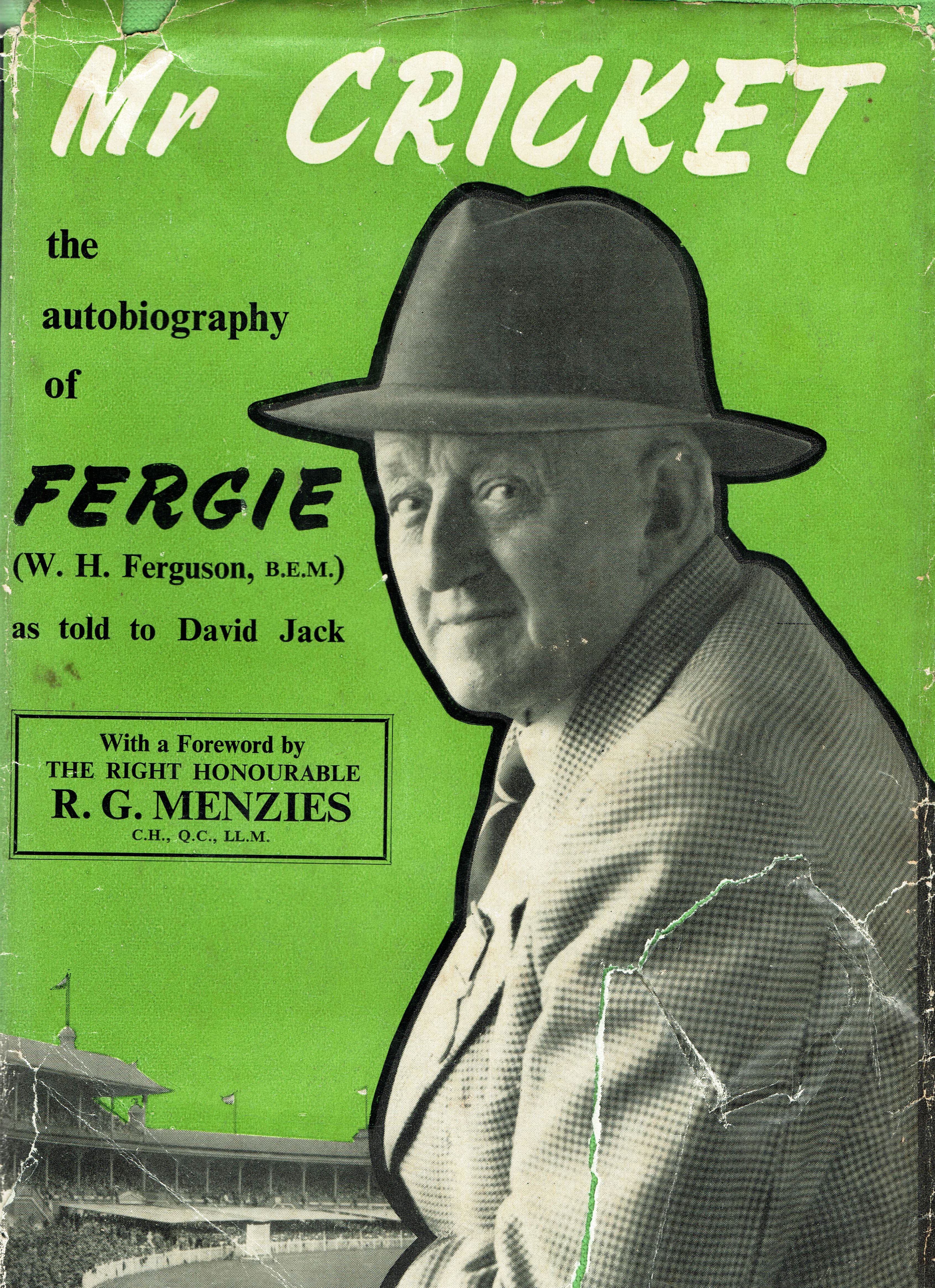
“Fergie”The original Mr. Cricket
It was just good fortune that David was not on board that fateful BEA aeroplane that crashed in Germany on 6th February 1958. David had travelled to Dublin in September 1957 to cover the European Cup preliminary round match between Manchester United against Shamrock Rovers and David had expected to travel to Belgrade to cover a later clash with Red Star Belgrade. David’s editor however, asked him to travel to Stockholm instead, to cover the 1958 FIFA World Cup draw, scheduled for 11th February 1958. The eight journalists who died on board the flight at Munich, returning to England from Belgrade, were all grouped together at the rear of the plane. There was every chance that at the age of four, I could have lost my father, had he travelled to Belgrade.
This was a very difficult time in David’s life. Those journalists who perished at Munich were his friends as well as being colleagues. Two weeks earlier, David’s mother Kathleen died followed, as did his father, later in 1958. After the Munich crash, David was posted permanently by his newspaper to the North West of England.
Sept. 1957 Manchester journalists in Dublin. Five would perish at Munich
David continued to write sports related biographies, including books on footballers Tom Finney and Jimmy McIlroy as well as Bill Ferguson the official scorer of the Australian cricket team for many years who had travelled with all the famous Australian cricketers, Bradman included, in the first half of the 20th century. The foreword to the book was written by Australian Prime Minister R G Menzies.
Seeking a new challenge, in 1965, Dad decided that he and my mother would buy a newsagency at Thornton Cleveleys near Blackpool. David continued to write on football and in 1965 was elected Chairman of the Football Writers’ Association (“FWA”) – the first freelance writer to be appointed to that position. As sitting chairman of the FWA, David had the honour of presenting Bobby Charlton with his Footballer of the Year award in 1966, the year of the nation’s biggest ever footballing triumph, the winning of the FIFA World Cup.
A time of early rising and absentee paper boys
By 1966, tired of getting up daily at 5.00 a.m. to take delivery of the morning newspapers and filling in for absentee paper boys in the snow and rain, David decided that the family would emigrate to Australia. In February 1967, David and his family embarked from Southampton on the Chandris Lines ship “S.S. Australis”. The total cost under the assisted passage scheme was just £20 and motivation for this significant life change, was the promise of sunshine and the suggestion that the warmer climate might assist my brother Paul’s asthma.
All on board for Australia on the SS Australis
Setting off from England in 1967, David had no employment guarantee but still nine mouths to feed. Upon arriving in Australia, David had to prove his worth as a journalist, which he achieved by writing a series of articles for Pix magazine. One in particular on Australian jockey Mel Schumacher, caught the notice of the industry and as the Sydney Sun did not have a full time soccer writer. David was offered a permanent job in April 1967. Recognizing that a football environment did exist down under, David soon became an important part of Australian football. Having been used to receiving as much column space as was needed in the United Kingdom, David was often frustrated by the lack of paragraphs allocated here, to what was a minor sport at the professional level. His pleas to his sports’ editors often fell on deaf ears but he continued to try to grow the visibility of Australian football encouraging his employer to support football at the grass roots level.
David Jack (centre) at coaching clinics promoted by the Sun newspaper
David was convinced that the way forward for Australian soccer was to attract the non committed fans of the rugby codes and Aussie Rules and to entice Australians and the latent British football fans down under, to watch local soccer. David wanted to have club names changed to clearly identify with a local district rather than having a connection to a European nation. David felt that this was the only way to appeal to the greater population. Though this would be frowned upon today, David’s forceful writings on this subject were not motivated by racial bias but a burning desire to make the whole nation embrace soccer in this country. David had a very good association with the clubs, officials and supporters of those clubs sponsored and supported by post World War II immigrants and he wanted to retain the support of these groups but supplement them with disenchanted rugby and Aussie Rules followers.
LEAD Technologies Inc. V1.01
David was never afraid to speak his mind – his experience in the Wolves v Birmingham match attests to this and soon after starting with The Sun newspaper, he had a falling out with his long time friend, Matt Busby. Manchester United played a Sydney XI here in June 1967 and Sydney’s Ron Giles suffered a broken jaw after an off the ball scuffle with United’s livewire, striker Denis Law. David reported Law’s “involvement” in the incident, upsetting Busby the respected Scottish born manager, who would have preferred the incident to be hushed up. Busby, a man of integrity, apologized to David, soon after.
Australia’s qualification for the 1974 FIFA World Cup brought widespread optimism for the future of the game and the media started to provide more coverage of Australian soccer. As a result, David was asked to host a soccer segment on Sunday mornings on Channel 7’s Sports Action which later became Sports World, chaired by former rugby league and union international, Rex Mossop. The weekly appearance was far from lucrative for David, although I do remember the family being well stocked with “delicious hams from Meapro” and numerous bottles of Patra orange juice.
The short lived Soccer Monthly News
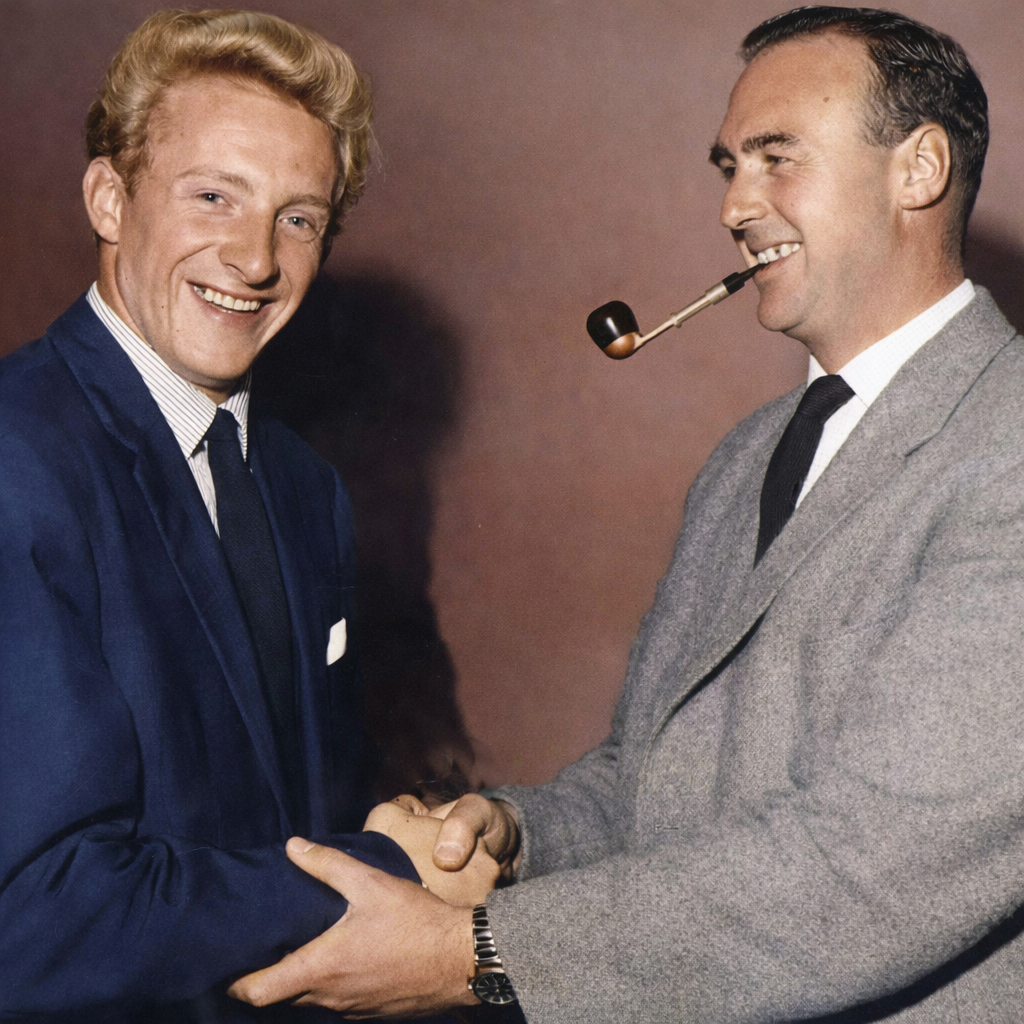
David travelled to the 1974 World Cup Finals in West Germany and by this time, he was happy with his lot in Australia and never contemplated returning to the UK. David’s trademark pipe was familiar with the local football fraternity and David continued to be outspoken about the local game and he received more than one threat of legal action from Sir Arthur George, then chairman of the Australian Soccer Federation. David founded the Australian Soccer Weekly and Soccer Monthly News and sought interest from local publishers for writing a number of books, including the Australian coach, Rale Rasic’s life story. Australian football unfortunately had still not captivated the population sufficiently to attract publishers to Australian football or its’ characters. David did collaborate with Andrew Clues, a UK ex patriot coach in the writing of “Soccer for Coaches & Players” (Australia & New Zealand Book Company 1977). Clues had high hopes for the book, however to this day it remains a “collector’s item”
Until his dying day, David strongly advocated that Australia should not play football in summer and the matter was once debated on SBS television. The former SBS presenter Les Murray and one time Australian coach Eddie Thompson argued in favour of playing in summer. Now, however, whenever watching a local A League game and the heat results in players taking mid half drinks breaks, I think of Dad and say to myself “You were right”!
David lived most of his Australian life on Sydney’s Northern Beaches, notably Fairlight and Harbord (Freshwater) spending many hours on Freshwater Beach, caked in Coppertone sun tan lotion, listening to his adopted country playing cricket against the country of his birth. David continued to play tennis regularly on the court at his and mum’s Harbord home. David often promised an appearance from Ivan Lendl, apparently a friend of the then Sun photographer, Anton Cermak. Lendl never fronted so we had to make do with a less than talented tennis player in Socceroos coach, Rudi Gutendorf.
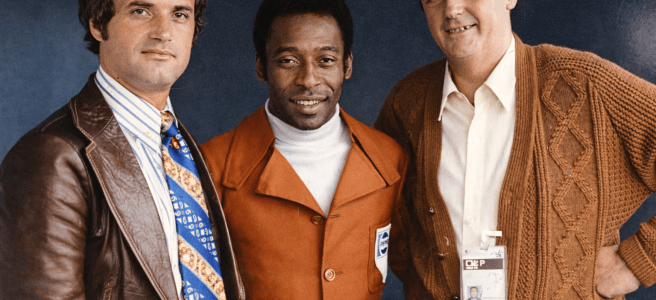
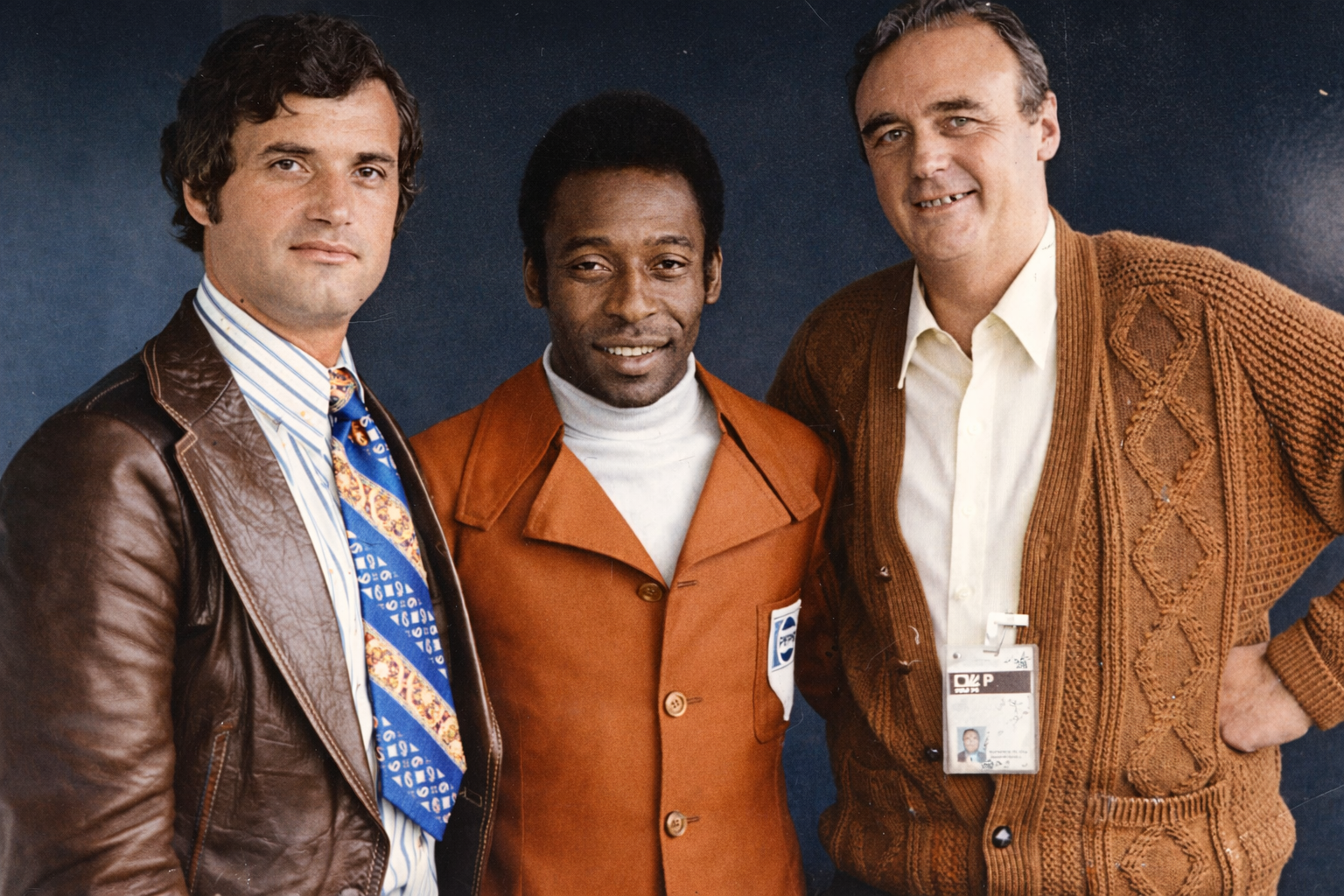
A coach, the G.O.A.T and a journalist at the World Cup in 1974
David married Rose Costelloe in December 1950. Rose came from the seaside town of Ballybunion, County Kerry and she and David had seven children. From their wedding day onwards, Rose understood very well the ramifications of marrying into a committed professional sporting family. The wedding ceremony had to be at 11.00 a.m. as her father in law, DBN Jack was then manager of Middlesborough F.C. who were kicking off at White Hart Lane at 3.00 p.m. against Tottenham Hotspurs. The wedding was specifically arranged for that day, to coincide with Middlesborough playing in London.
Wedding day, then off to watch Spurs v Middlesborough
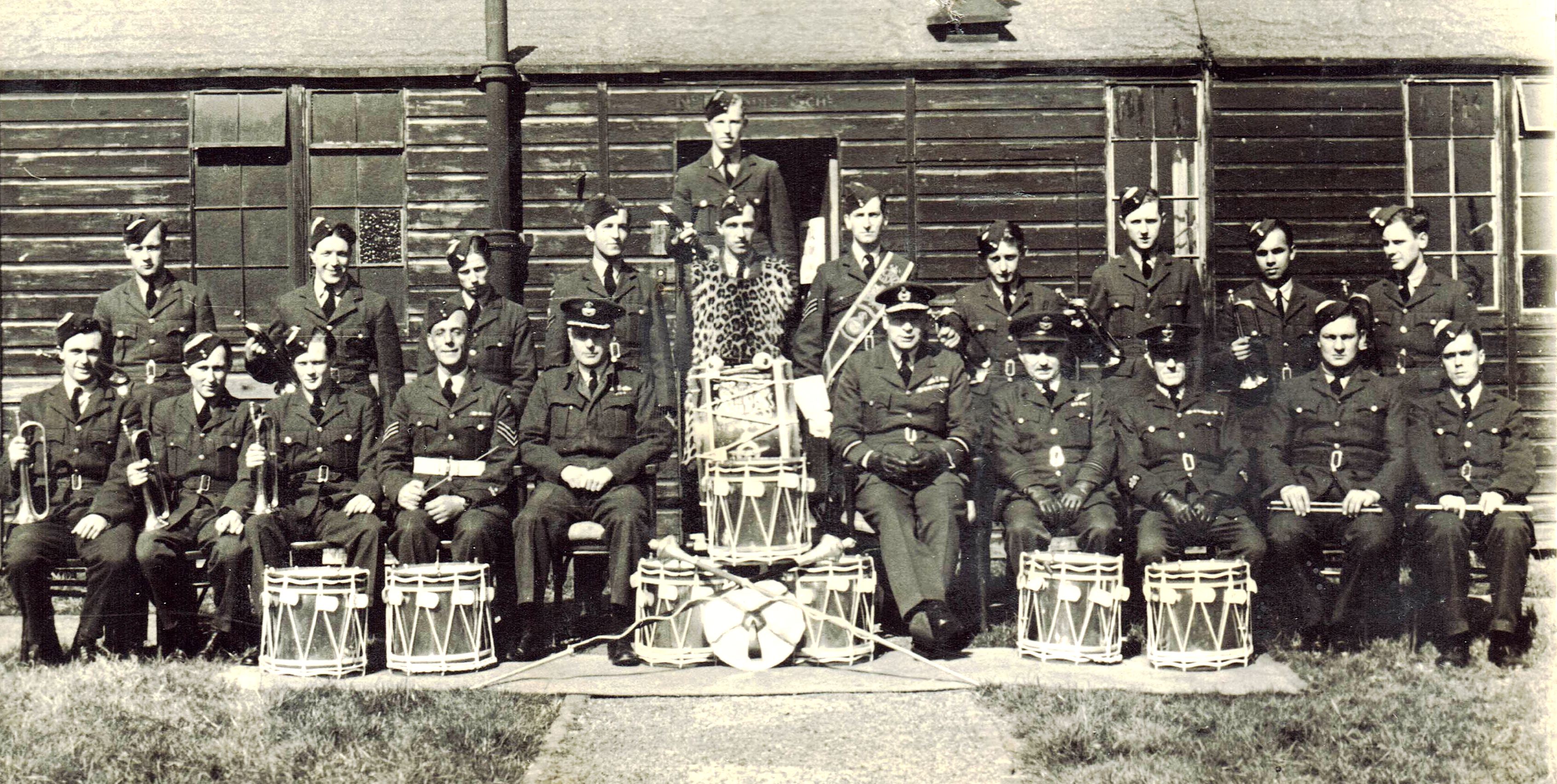
Aldershot RAF Band – David Jack far left front row
A competent piano player and armed services cornet player, David loved his music, especially Frank Sinatra, Sammy Davis Jnr. and Peggy Lee. He had played cornet in the RAF band at Aldershot during World War II and family photo albums indicate that cornet playing appeared to be David’s pre eminent contribution to the war effort. David however always insisted that he “kept the Sunderland (UK) skies clear of The Hun”. David had a very dry sense of humour, garnered from the British comedy greats of the 1950’s and 1960’s – Spike Milligan, The Goon Show, Tony Hancock, Sid James and of course the silliness of Benny Hill.
David was always calm and thoughtful and loved all of his children equally and they loved him similarly in return. David Jack retired from sports journalism in 1988 and he and Rose moved down to Sussex Inlet on the NSW south coast. David continued to write for the local Probus club. He even started to march on ANZAC Day, perhaps reminiscing about his Royal Air Force days when he could produce some beautiful sounds on his RAF cornet.
David Ronald Jack died on 1st June 1990 at the age of 64.
Rest in peace Dad.
P.S. All of David’s published books are still selling consistently.











![George_Best[1]](https://djcjack.com/wp-content/uploads/2014/11/george_best1.jpg)
![GB%20Versus%20Chelsea[1]](https://djcjack.com/wp-content/uploads/2014/11/gb20versus20chelsea1.jpg)
![item_4664[1]](https://djcjack.com/wp-content/uploads/2014/11/item_46641.jpg)















 David Jack