
-
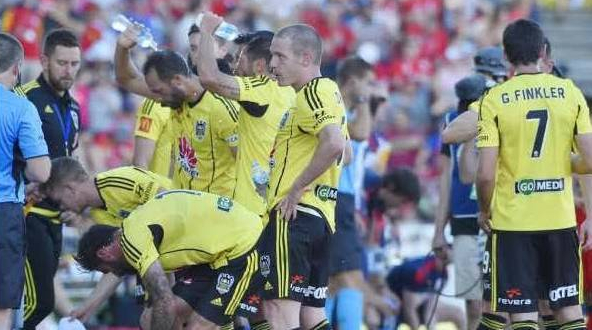
- Wellington Phoenix players take some heat relief
As I sit here at midnight on a February evening in the stifling heat and humidity of suburban Sydney, I feel most uncomfortable. Sweat is dripping off my brow and the last thing I would want to do at the moment, is chase a ball around a football pitch. If however I was an A League or W League professional footballer, this would be my lot for the greater part of my football season and not in the comparative cool of midnight.
Back in 1984, crowds attending the Australian National Soccer League (NSL) were on the decline. Desperate times called for desperate measures. When the switch from playing football in winter to the warmer summer months was mooted that same year, then NSL General Manager, Stefan Kamasz, stated that the push to change to a summer season (which didn’t materialise until 1989), related entirely to the diminishing NSL crowds. The proposed switch to a summer soccer season was completely driven by negativity – a fear of competition from the other football variants.


During an SBS televised debate in 1984, Eddie Thompson, the former Australian national team coach said that playing in summer, would mean that soccer would only have to compete with cricket for spectators and media coverage. Thompson also said that “cricket was not everybody’s cup of tea,” although I would have expected no less a comment from a Scotsman.
No longer does soccer have competition solely from cricket and a couple of tennis tournaments. Without leaving our living rooms, we can now watch a range of sports from all around the world, including cricket’s Big Bash League, baseball, NBA, UFC and various forms of racing. When newspaper coverage of National Rugby League and Australian Rules Football can exceed four pages in their non playing months of November, December and January, the battle for print media exposure is still clearly evident.

- The 1984 Summer Soccer think tank – SBS Television
Now in 2019, attendances at our national league matches are again on a worrying downward slide and TV viewing audiences are not holding up any better. Eddie Cochran in 1958 sang that “there ain’t no cure for the summertime blues.” As far as our current attendance blues are concerned, my partial cure would be to revert to playing our football primarily in the winter months, a far more favourable climate for the world game.
Playing Australia’s foremost men’s and women’s football competitions, the A League and W League in the summer months when heat and humidity will sap the energy of even the fittest of professional players, does not make sense. U.S. WW2 General George Patten said “fatigue makes cowards of us all” and there is no doubt that the often oppressive conditions in summer, detract from the player’s energy and performance. Players make elementary errors simply due to fatigue. To improve crowds, we need to provide a better product that will thrill and excite the crowds. Playing matches in excessive heat will not increase the speed nor intensity of the games, basic skill levels drop and consequently the match as a spectacle will suffer. The essential drink’s breaks in extreme conditions also creates an unwelcome disruption to the traditional flow of the game.

- American tennis player Jack Sock suffering from extreme heat stress
The original intention with summer soccer was for all games to be played in the evenings when it was expected that the temperatures would be more moderate. This has not been the case however, with late afternoon kick offs commonplace and the Women’s League starting even earlier. A recent A League fixture between Adelaide United and Brisbane Roar kicked off at 7.30 p.m. and yet the temperature was still thirty one degrees Celsius. Global warming is a fact that we cannot ignore. In NSW in January 2019, average day and night time temperatures in thirty two centres, were the highest ever recorded. If we continue to play professional football matches in the increasingly hot Australian summers, the health risks for our players could be dire.
The summer soccer protagonists claimed that football fans wouldn’t want to go out at night in the winter months. The Australian winter in the major cities /football centres is not harsh, in fact it is quite mild during most months other than July and August. Football spectators in the colder climates in Europe have coped successfully with winter seasons for over 100 years and if local fans have to wear a coat and scarf to go out and watch a football match, that should not deter them.

- Brisbane Roar take time out in the sweltering Adelaide heat
Former NSL General Manager, Stefan Kamasz and many proponents of a summer soccer season also contended that the game was competing for spectators with itself in winter. The thinking was that grassroots players – men, women and children would not be playing in the summer, and would therefore be able to attend the senior professional competition games. This is true to an extent, however I would suggest that when the youngsters themselves are in season and playing in the morning or early afternoon, they would be more likely to be in the mood to attend an A League or W League game. When temperatures exceed thirty degrees Celsius in summer and the children’s football boots are gathering dust in the bottom of their wardrobe, I would say that the beach or a swimming pool would be theirs and their parent’s first consideration.
The availability of grounds from March to November should not be insurmountable with the current push towards “boutique”/ smaller grounds. If rugby and AFL competition at the major venues was an issue, there would be a number of smaller suburban stadia that could accommodate crowds of 15,000 – 20,000 people. Australian soccer cannot presently command crowds of 30,000 spectators consistently, so large capacity arenas are not necessary at the moment.

- Not quite the Australian winter
Our “winter” football season should extend from early March to mid November with no break. This would align us with the seasons of our Asian Football Confederation colleagues and would provide for an off season of around three and a half months, far more practical than the current five month layoff. The popular Football Federation Australia (FFA) Cup could take place during the season with the final taking place at season’s end. Currently the timing of the FFA Cup finale is anticlimactic, taking place very early in the A League season. Both National Premier League (NPL) and A League clubs would then have equitable preparation for the cup competition, unlike the present situation. Also, any Australian club progressing to the latter stages of the Asian Champions League would not be disadvantaged, by playing an Asian opponent, when they are out of season. Furthermore, overseas teams visiting Australia on their fundraising, replica shirt selling, “An Evening with Joe Bloggs” junkets, could expect sterner competition from season hardened local opponents, rather than a disjointed rabble of match shy players, who clearly would prefer to be at Bondi Beach.
Association football has thrived throughout the world for 140 years. In Australia, it’s time for us to stop worrying about competition, cease consistently looking over our shoulders and take all the steps necessary to focus on advancing our game in this country. It’s time to admit that the summer soccer experiment has not worked. Reverting to a winter football season for our men’s and women’s premier competitions would help raise the the standard and intensity of matches, improve player comfort and safety and bring our national leagues’ season into alignment with the rest of the football community, both in Australia and in Asia.
With the breaking news that the FFA is considering a shortened 2019-20 season to cater for the A League expansion, this would present an ideal opportunity for the launch of winter football for our male and female professional leagues in March 2020. Australian football, as Paul McCartney once sang of Jo Jo, needs to get back to where it once belonged – winter.
© David Jack 2019

![George_Best[1]](https://djcjack.com/wp-content/uploads/2014/11/george_best1.jpg)
![GB%20Versus%20Chelsea[1]](https://djcjack.com/wp-content/uploads/2014/11/gb20versus20chelsea1.jpg)
![item_4664[1]](https://djcjack.com/wp-content/uploads/2014/11/item_46641.jpg)
 David Jack