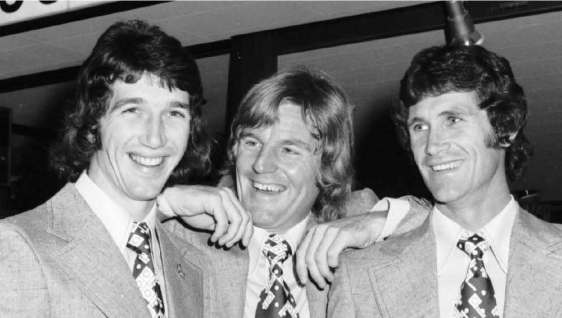
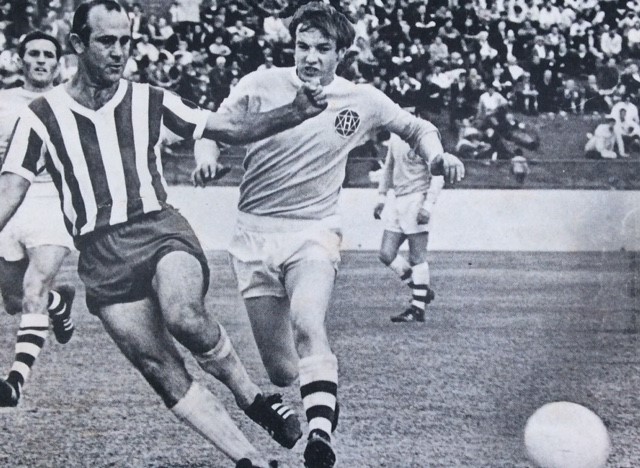
Socceroos Adrian Alston (left) & Max Tolson (right) on the losing side at Woonona Oval May 1968
I have been watching club and international football in Australia since 1967 and if asked to nominate the most memorable match I have witnessed in over 50 years, there are many contenders. Some might expect the 2005 Australia v Uruguay World Cup play off at Homebush Stadium or others might plump for the classic 2013 A League Grand Final, snatched by Brisbane Roar from Central Coast Mariners in quite dramatic circumstances. Then of course there was the tragic, yet so memorable World Cup loss to Iran in Melbourne in November 1997.
Going further back, in October 1979, I saw the glitz and glamour of the New York Cosmos take on Australia at that most unlikely of football grounds, the Sydney Showground. The Showground was overflowing that night (I watched the second half from the touchline), playing host to football luminaries, Franz Beckenbauer, Carlos Alberto and Johann Neeskens. Also at the same venue in 1967, I twice saw reigning English First Division champions Manchester United, with George Best, Denis Law and Bobby Charlton in their prime, take on a team of local part timers.
All great occasions, but the game that I still remember more fondly than any, was a NSW Soccer Federation match that took place at Woonona Oval on 26th May 1968. I was a 14 year old Manly Warringah junior representative player and on that day I travelled with a single coachload of Manly fans to watch our team, Manly Warringah United take on South Coast United, at what was South Coast United’s “fortress,” decades before this term became popular with football fans.
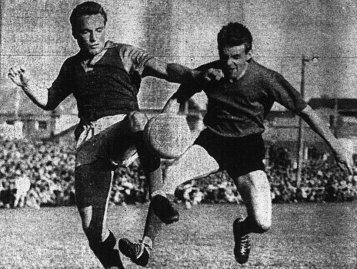
Woonona Oval 1960’s South Coast United v Apia Leichhardt
South Coast United played their home games at Woonona Oval (it was not in fact an oval), a quaint but unfashionable venue north of Wollongong. This compact, rectangular ground was ideal for watching football. It was also conducive to playing good football, being consistently well grassed. The sole miniature grandstand at the southern end of the ground, also housed the dressing rooms. When the local fans were at their most raucous, having to trundle through the South Coast faithful onto and off the pitch was a daunting experience
On that bleak May afternoon in 1968, about 2,500 home fans and at best, 60 Manly fans had packed into Woonona Oval, to witness the inevitable home team victory. Manly, promoted that season from the second division, had not yet won a match and were firmly rooted at the bottom of the NSW Federation 1st Division table. By that stage of the season, Manly had endured a succession of debilitating defeats, punctuated by the very occasional draw. The threat of relegation always added spice to their games and it was no wonder that the team approached this match at Woonona, with more than a little trepidation.
South Coast United, boasted a large contingent of British players, many recruited by Jimmy Kelly, their player – coach and former English professional. That year they also had a tall, strong young striker in Max Tolson and an equally tall 19 year old Lancashire lad, Adrian Alston, both of whom later were to become members of the 1974 Australian World Cup squad.
The boisterous local crowd were rocked in the 37th minute when Manly took a surprise lead. The home side failed to clear the ball in their penalty area and Manly’s inside left, Archie Harris pounced. Harris a slightly built Scotsman with a skilful touch, controlled the ball and deftly slotted it past George Ramage in the South Coast United goal.
Before the travelling rugged up Manly supporters could toast on their cups of tea, the home side struck back immediately. Ron McGarry, yet another Englishman finally managed to beat Manly goalkeeper Jan Tuinman giving the beseiged custodian no chance with his shot from close range. At 1-1 our coachload of Manly supporters shrugged and consoled ourselves in the knowledge that a return to the second division might herald a return to a victory or two.
Manly’s Hungarian born coach, Denis Adrigan played a counter attacking style of football, not through desire but because it was the only option when his team was under pressure for 90 minutes of every game. That they didn’t suffer more substantial losses in the 1968 season was in no small part due to the brilliant Jan Tuinman, whose performances that campaign saw him remain in the top division with Yugal Prague and Pan Hellenic, following the inevitable relegation of his Manly colleagues.
The sorry tale of Manly Warringah United’s 1968 season
The game ebbed away and the travelling support would have been extremely happy with a 1-1 draw at the Woonona footballing graveyard. Fifteen minutes from full time, Manly left back and motor cycle enthusiast Gary Brooks, of the handsome visage and Elvis Presley slicked back jet black hair, played a long ball deep into the South Coast United half. Manly’s speedy diminutive left winger Colin Waller, pounced on the ball outpacing the home defence. Waller, who was a more than handy golfer, from the edge of the penatly area sunk his eighteen metre putt assuredly into the corner of substitute goalkeeper Radburn’s net. Manly were up 2-1. Do miracles happen ?
Two of Manly 1968 Heroes Jimmy Hughes (far left) & Hughie Hendry (far right) pictured in 1983
As full time approached, South Coast continued to batter the Manly defence but some incredible goalkeeping by Tuinman enabled Manly to hang on for what was was to be their only victory of that 1968 season.
Manly goalkeeper Jan Tuinman
Considering an almost identical South Coast United team won the NSW Federation premiership the following season, Manly’s victory at Woonona that afternoon, was even more remarkable. The two and a half hour coach trip home was euphoric and the celebrations resembled those of a team that had just been crowned champions.
Now readers might say that’s a nice little football story but what is the point ? The point is that although our top local club football leagues, the Hyundai A League and W League and the various NPL competitions may not be of the standard of an English Premier League, a Bundesliga or La Liga, irrespective of the standard of play, Australian club football can be entertaining, exciting and most enjoyable. I look no further than Woonona Oval, May 26th 1968.
Bobby Moore and the England team celebrate their famous 1966 World Cup win
Too many years have passed since 1966 but for football fans in England, that year came to a climax on Saturday 30th July, the day on which England won the World Cup. As a young boy living in England at that time, that World Cup held special memories for me, memories that will remain with me forever.
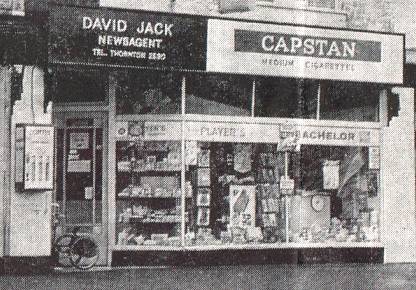
At the time I was a football mad 12 year old Manchester United supporter. In late 1965 my father, then a football writer with the News of the World, inexplicably decided we should move from our comfortable home, 20 minutes drive from Old Trafford to a small town 40 miles away called Thornton Cleveleys. Dad chose to purchase a newsagency in this little village which was certainly not a centre of high commerce in Lancashire. The rationale for the unexpected newsagency venture was never shared with our mum Rose or the 7 children. We can only assume that Dad thought that he would enjoy getting up at 4.30 a.m. every morning, work 14 hour days and deliver newspapers in the wind, rain and snow. This business venture would not be provident for me on World Cup Final day 30th July 1966
My parents’ newsagency at Thornton Cleveleys, Lancashire…and the paper boys who didn’t front on 30th July 1966
Football was in my father’s blood and despite the business purchase, he would continue to work as a freelance football writer in conjunction with selling newspapers and 20 packs of Woodbine cigarettes. Of course Dad was in the press box at Wembley Stadium on that special day in July 1966 to watch the historic match. It was a match of such footballing significance that England had never before contested nor has since. On that day, others would be left to manage the demands of the Thornton Cleveleys newsagency.
By early 1966, I was coming to grips with our move from Manchester, accepting that my Old Trafford visits would be more infrequent in the future. Our new home did however have some advantages for a United fan, as manager Matt (later to be Sir Matt) Busby frequently used to take his squad to nearby Blackpool, to prepare for games. The team would stay at the Norbreck Hotel on the beachfront and my friends and I could sit and watch United training on the lawns of the hotel. Soon to be England World Cup heroes, Bobby Charlton and Nobby Stiles, would be playing 5 a side games only metres from where we would be sitting and interaction between players and onlookers was quite common.
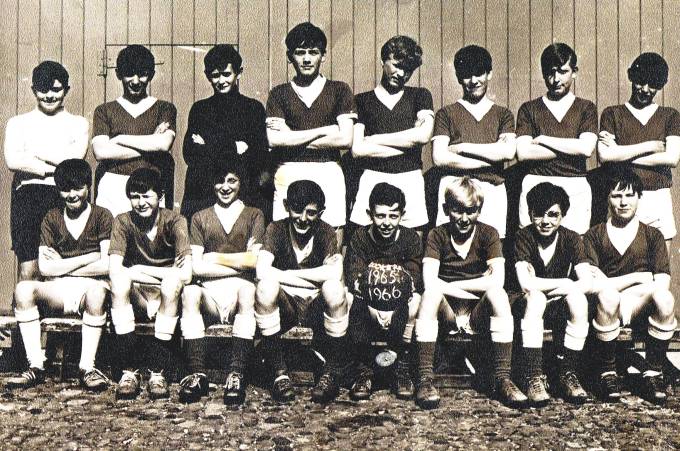
That’s me, 12 years old, far left, front row Preston Catholic College 1966
The 1966 World Cup drama unfolded before a ball had been kicked with the cup, then known as the Jules Rimet trophy being stolen from it’s temporary home in London. It was later found wrapped in newspaper in a London suburban garden, by a collie dog called Pickles. The portents were there for what was not going to be an ordinary World Cup competition.
For English football fans, the cup opened with much expectation, possibly too much as England were kept scoreless against Uruguay. For a Manchester United fan however, it was inevitable that Bobby Charlton would light the fuse on England’s road to World Cup glory. In England’s second group match against Mexico, a typical Charlton burst from inside his own half ended with a 25 metre rocket into the Mexican net. It was a wonderful goal and despite an unimpressive win over France in their final group match, England qualified for the quarter finals.
Bobby Charlton’s piledriver opens the scoring against Mexico
The Brazilians came to England as favourites. My father who in Sweden and Chile had seen Brazil’s previous World Cup victories, rated Pele, Garrincha and company very highly. Unfortunately aside from a magnificent Garrincha free kick scored against Bulgaria, the Samba Boys struggled. Pele particularly, suffered brutal treatment from the Bulgarians and Portugese and as in Chile in 1962 the footballing superstar was on the periphery for the tournament.
I attended one match in the tournament, a group game at Old Trafford. Eusebio da Silva Ferreira the greatest player to have come out of the African continent, scored for Portugal in a 3-0 victory over Bulgaria. That Lancashire based group witnessed one of the best ever world cup matches when Hungary beat Brazil 3-1 to knock out the favourites. I clearly remember watching on black and white television, the Hungarian’s second goal – a stunning volley by Janos Farkas after Florein Albert and Ferenc Bene combined beautifully. This will go down as one of world cup’s greatest ever goals.
Janos Farkas celebrates after scoring his wonder goal against Brazil
My World Cup memories include a slight North Korean player named Pak Doo Ik scoring the only goal of the game at Middlesborough to send the Italians packing. Italy, boasting the legendary names Mazzola, Rivera and Facchetti were outplayed by the marauding North Koreans who could have scored three that day. The English Press, at that time not big fans of Italian football, were only too happy to report on the tomato pelting The Azzurri faced upon their return to Italy.
Coin toss Italy v North Korea July 1966Jubilant North Koreans after defeating Italy 1-0
The West Germans and the Argentinians cruised through their groups, the Germans inspired by Franz Beckenbauer, yet to be crowned Der Kaiser. When the Argentine captain Antonio Rattin was sent off (somewhat harshly I can say 47 years later ) in the quarter final against England at Wembley, relations between the two nations sunk to depths only surpassed by the Falklands War, many years later. England manager Alf Ramsey branded the Argentine players “animals” and Ramsey physically intervened to stop players exchanging shirts at full time.
Portugal’s amazing 5-3 quarter final victory over North Korea and four Eusebio goals meant that England would have to face the in form Portugese in the semi final. There was minor controversy when the game was conveniently (for England) switched from provincial Goodison Park to Wembley. England had played all their games at Wembley but if this move had upset the Portugese, which certainly it had, the English press weren’t reporting it. Once again Manchester United’s Bobby Charlton was the matchwinner scoring both goals in the semi final as England beat Portugal by the odd goal in three. We all looked forward to Saturday 30th July 1966 and the final against West Germany.
England & West Germany line up for the 1966 World Cup Final
I had been brought up on boy’s magazines, TheVictor and TheRover, where invariably the cover story centred around some act of heroism by a British soldier almost always against the Germans in World Wars 1 or 2. Being an avid and gullible reader, I had the utmost confidence that, as in the comic books, England would beat West Germany to win the World Cup final just because we were the “good guys”. That the home country were to wear Manchester United red in the final was one good reason to expect an England win.
In July 1966 The Kinks were on top of the pop charts with Sunny Afternoon but on the Saturday morning of the match, there had been drenching rain at the Empire Stadium in London. By midday however the rain had cleared for what all England hoped would be a very sunny afternoon.
Wolfgang Weber scores West Germany’s last minute equaliser – so near yet so far for England ?
Helmut Haller, a dynamic blonde striker opened the scoring for the Germans after 12 minutes. England equalized soon after through Geoff Hurst, the find of the tournament and when his West Ham colleague Martin Peters put England ahead in the 78th minute, all of England sensed our time had come for football glory. The 90th minute and West Germany are awarded a free kick on the edge of the penalty box. When the ball is deflected more than once and ends up within the outstretched foot of Wolfgang Weber, we prayed for a miracle but goalkeeper Gordon Banks was beaten. It was 2-2 and extra time beckoned.
When Weber slid home this agonising, 90th minute equalizer at Wembley Stadium on 30th July 1966, forcing the World Cup Final to extra time, not one of the seven regular paper boys turned up to the Thornton Cleveley’s newsagency to deliver the Saturday afternoon papers. Our mother Rose said to big sister Theresa and I “the papers must go out – off you go”. Despite my pleas, I missed that historic half an hour of football.
I’m on my Raleigh pushbike and delivering newspapers like a paper boy possessed. Ninety eight minutes into the match and the redheaded Alan Ball makes another exhaustive run down the right touchline and cuts the ball back. Geoff Hurst kills the ball and crashes a shot against the underside of the crossbar. Surely the ball was over the line. “no” say the Germans. Swiss referee Gottfried Dienst consults with his Russian linesman and without hesitation, the linesman nods in the affirmative and the goal is awarded. It’s 3-2 and the German players are distraught – England euphoric. To this day the Germans won’t accept that this third goal was legitimate
Geoff Hurst’s controversial third goal for England – was it over the line ?
West Germany continues to press for an equalizer then Bobby Moore releases Geoff Hurst into the West German half. Alan Ball, socks around his ankles, is away to Hurst’s right but Hurst ploughs ahead towards the West German penalty area. Spectators are already on the pitch when the BBC’s Kenneth Wolstenholme utters possibly the best known words in the history of football commentary “some people are on the pitch. They think it’s all over – it is now” as Geoff Hurst smashes the ball past the weary German goalkeeper, Hans Tilkowski. Jubilation for England – utter despair for the courageous West German team.
England had won the World Cup, my parent’s customers got their newspapers and I got paid two shillings for the paper round. Even Pickles the collie dog had reason to be happy, being invited to the official England World Cup celebrations. Of course, I did eventually get to see that magical thirty minutes of extra time and have relived the tournament many times, courtesy of the wonderful documentary “Goal”
Bobby Charlton holds aloft the Jules Rimet World Cup trophy
As a music lover, I consider myself blessed to have been brought up in England in the swinging sixties but also as a football fan, I could have wished for nothing better than to witness the country of my birth, England win the World Cup in my homeland
Alessandro Del Piero has been a great footballer and would probably rate in the top 5 Italian players of all time. He continues to deliver in the A-League, not the playground of the most technical players but nevertheless a league that is fast and physical. In A-League History “Il Pinturicchio’s” goalscoring record is quite outstanding on a goals per game average.
There is however an aspect to his game that is dividing fans and football purists. Alessandro Del Piero is suffering from the “Humpty Dumpty” syndrome. He can’t stop falling down and all the king’s horses and men, in the form of Fox Sports and SBS Football commentators are not just turning a blind eye to this aspect of his game, but praising him effusively for this practice.
Whether he is impeded by an opponent, runs into one or kicks a player in the lower leg so that he can fall over (don’t laugh), Del Piero can achieve the same result – a free kick. In modern football apparently this practice, known as “drawing the foul” is called a skill. You will probably find it on page 13 of “Football in the 21st Century”.
Del Piero’s play acting is described by his coach, Frank Farina as the sign of a “genius”. Farina’s theory is glowingly supported by the TV football networks. Of course these stakeholders all have a vested interest (TV ratings) in putting the most positive spin on the antics of the Italian “genius”.
It’s clear that Del Piero no longer has the pace to go past players, so rather than lose the ball, he will collide with an opponent or in the case of the comical goal he scored against the Newcastle Jets earlier this year, the defenders will collide with themselves. Let’s stop this façade. A player falling over at the slightest touch is not a skill to be lauded or the sign of a genius. It’s gamesmanship to be kind, cheating to be blunt.
One concern with Del Piero and his Humpty Dumpty tactics is that young Australian players are going to imitate Del Piero and attempt to “draw the foul”. (I really dislike this phrase) The other important concern is that the number of “fouls” committed on Del Piero has a detrimental effect on the match as a spectacle. I love to watch a good football match with flowing moves and attackers using their skills to beat defenders. Where there are maybe 40 free kicks in a game however the match becomes much less enjoyable.
I think back to the days of Garrincha, Pele, Stanley Matthews, Johan Cryuff and George Best, all wonderful dribblers of the ball. These truly great players would never have let an opponent bring them down, if at all possible but would delight in the many ways in which they could go past their opponents and in the case of Best, often beat the same player twice.
The Del Piero “brand” itself guarantees that 90% of his tumbles are rewarded with a free kick primarily because he is Alessandro Del Piero. Referees have double standards and should treat Del Piero exactly as they would other players. Jeronimo Neumann from Adelaide United, going to ground in similar situations, would accumulate many cards but Del Piero is apparently immune to censure. Del Piero is not the only guilty player but is the most prolific in earning free kicks. There are many A-League players, including Thomas Broich and Matt Simon who also come to mind for exaggerating the extent of the tackle. I do not condone their behaviour either.
The A-League undoubtedly needs players of the calibre of Alessandro Del Piero – football superstars who can generate crowds and help grow the game in Australia. What Australian football doesn’t need is the boring spectacle of a game stopping every 90 seconds because Humpty Dumpty has fallen off his wall again.
By nature I am a very upbeat, positive person – the eternal optimist – so it goes against the grain for me to state that Australia will never win the World Cup. It is possible that FFA boss David Gallop could be right in predicting that eventually our brand of football will become the national game, but to win a World Cup is beyond all imagination.
I say this because Australia does not have a football culture, a pre requisite for winning the premier international football tournament. We have thousands of very talented boys and girls who love their football for 5 or 6 months a year but for most, that’s where it stops. I know that there are organised Futsal and 5 A Side competitions in the off season but participation rates are a fraction of those in the winter season. With a great climate and so many alternative pastimes (not least FIFA 2015), young Australian footballers have other distractions. As such they are not normally found honing their soccer skills in the warmer months. Until large numbers of kids voluntarily go down to the local park every afternoon to play with their friends, this country won’t produce truly great players.
Football in Europe and South America engulfs the lives of millions of people. Many people in South American nations have long endured great poverty and the only relief for most was, and still is, a football. In fact many kids did not even have a football but like Pele, made do with a grapefruit or a sock stuffed with newspapers and tied with string. Football became ingrained in the lives of South Americans and it was from their impoverished environment that many wonderful South American footballers emerged. Today the poorer nations, notably in Africa, are producing exceptional footballers. Like Pele, the first and greatest ever African footballer Eusebio, learned to play with an improvised football – newspapers wrapped up into a ball. Life expectations in poor African communities are very minimal but football can provide a means for young Africans to achieve status and financial security. Football is now the primary sporting recreation of most African nations and has become part of African culture. It is quite possible that the World Cup winner could be an African nation in the not too distant future.
The Black Pearl & The Black Panther – Pele & Eusebio
Though my family was not poor, I was the product of a “football culture.” As a boy in England, my life revolved around football. My grandfather captained England and is acknowledged as one of that country’s all time greats. My father was a football writer for 35 years and naturally I fell in love with the game very early in life. I grew up watching the best players in the U.K. and occasionally those of other nations and I tried to imitate them whenever I could find time. I would play in the driving rain and the snow and it was this devotion that consumed me. I was always in trouble because of football, whether coming home from school late with another pair of shoes destroyed, arriving after dark from playing at the local park or covered in mud from pretending I was a goalkeeper. I was obsessed by football to such an extent that we used to play football in the guard’s compartment of the train on the way to school. I loved football and though my career may not have panned out as it could have, living in a football environment was a major factor in my football development.
I have lived in Australia for 47 years and although we have produced some very good players, to be fair there have been very few exceptional ones. Our Australian kids are coached from the age of 5 & 6 but no amount of coaching is going to produce a Pele, Messi, Maradonna or Best. We have numerous private coaching academies and district representative coaching organisations around the country. You can write your coaching curricula and playing systems until the letters and numbers fade on your keyboard but no amount of textbook coaching is going to enable young Aussie players to embrace the spirit of the game, so important for producing outstanding players. If Australian parents were unable to take their children to training and games, would their offspring be prepared to travel regularly on public transport to play their football? I don’t believe that they would but I am sure that their counterparts in Africa and South America would find a way to get to their football match. It comes back to having a real love of the game, being part of a football culture. Unless the neighbours to the right of you and to the left of you are football fanatics and the bus driver asks you for the Sydney FC result, the football vibe will never become part of this nation’s DNA.
Barefoot youngsters in Ecuador hone their footballing skills
Can we create a football culture? Not the least of our obstacles is our geographical isolation. This and financial limitations, makes it extremely difficult to attract the best European and South American stars at the peak of their careers. Players who could inspire our young players, and prove real drawcards for the footballing public. Australia can provide short term financial gain for a few select marquee players, Alessandro Del Piero immediately comes to mind but with all due respect, the Del Piero who wore the Sydney FC shirt, was well past his peak. If he was to have come here 15 years earlier, his impact on Australian football would have been immense.
Alessandro Del Piero – a superb player but now past his prime
The established media is another barrier to developing a football culture or mindset. Though Rugby League registrations are at an embarrassingly low level and Rugby Union is not growing at youth level, the sporting media is still reluctant to give football enough coverage to make Australians more conscious of the round ball game. Though the game in this country has come a long way since the days of being viewed solely as a game played by immigrants, our brand of football still needs to be accepted by the wider community to become a dominant force in the Australian sporting environment.The Hyundai A League is currently at a level that will satisfy diehard Aussie football fans but not the unconverted. There has always been a core group of supporters for Australian club soccer but the A League needs a decided lift in the ability of the players and the consequent improvement in the standard of play to be able to poach fans from other football codes. Once this happens we are on our way to having a football culture. The popularity of soccer in Australia could then eclipse that of the other football codes, save AFL in Melbourne. This may in turn lay the seeds to create a football culture in Australia and a possible World Cup win. In the meantime, I will not be ordering my “Australia – World Cup Winners” tee shirt just yet.
A BRIEF HISTORY OF GUEST AND MARQUEE PLAYERS IN AUSTRALIAN FOOTBALL
Melbourne City prize recruit David Villa
The signing of Spanish star David Villa by Melbourne City for an alleged 10 game stint prior to the 2014-15 A League season was thought to be the icing on a cakeful of guest / marquee players who have turned out for Australian clubs over more than fifty years. Aussie signings didn’t appear to come much better than Villa. A then current Spanish international and World Cup squad member, Villa was still scoring goals for the reigning world champions. How could a player of Villa’s quality be anything but a huge success, a massive fillip for the local game ? Well Villa’s Melbourne City stint was cut very short and with such a name player failing to produce the goods, it’s worth looking back on our football history to assess whether the presence of overseas “stars” has produced a positive return for the local game ?
I first appreciated the value and pulling power of an overseas guest player in the winter of 1968 at L. M. Graham Reserve Manly, a suburban football ground that now doubles as a dog park. On that Sunday afternoon Takis Loukanidis, capped 26 times for Greece came to Graham’s Reserve. I was a 14 year old youth player with Manly and our senior team were playing Pan Hellenic, one of the big drawcards in the old NSW Federation Division One.
Arriving late in the week, Loukanidis did not play that Sunday afternoon but that did not stop 4,500 fans turning up in the hope of catching a glimpse of the Greek star. At half time Loukanidis took a stroll around the pitch perimeter before entering the public toilet. I clearly remember 300 Hellenic fans following Loukanidis around the ground and parking themselves outside that very unfashionable men’s toilet. The presence of Loukanidis doubled the probable crowd figure that day and one benefit of a guest player was immediately evident.
Takis Loukanidis challenged by Hakoah’s Chris Spilarewicz at the Sydney Sportsground
At 30 years of age, this was Loukanidis’s first stint in Sydney with Pan Hellenic, the best supported, but perennial underachievers in the NSW Federation. Hellenic came second that season, their highest position during the Pan Hellenic (pre Sydney Olympic) years. Loukanidis was an inspiration to the team and at 30 he was still sharp. Loukanidis’s magnetism swelled the Hellenic crowds and the regular chant of “Takis Takis” reverberating around their Wentworth Park home ground almost carried them to a first ever premiership. Loukanidis returned to Sydney the following year as player coach, but a year older his impact was less profound and Hellenic struggled for much of the season. As a guest player Loukanidis was a success, helping to improve the performance of Pan Hellenic and boost their gate receipts.
Takis Loukanidis is only one of dozens of notable overseas players who have had played for Australian clubs with varying degrees of success. The first foreign players to have an impact on the local game and possibly the greatest from a playing perspective, were Leo Baumgartner, Walter Tamandl and Karl Jaros. Having toured Australia in 1957 with the crack Austrian club, F K Vienna, Baumgartner and Tamandl fell in love with the Australian beaches, the climate and the way of life and were not swayed solely by the size of the promised pay packet.
With Baumgartner, Tamandl, Jaros and another Austrian Herbert Ninaus, (Sydney based) Prague swept all before them in the NSW Federation First Division in 1959, State Federations being the highest level of competition at that time. These players all in their late twenties and at the peak of the ability, helped to grow the crowds and raise the profile of Australian soccer. The overall standard of football also improved as other clubs were compelled to recruit overseas to match the performance of the glamour club, Prague. This was a golden era for Australian football and the four Austrians and the well supported “migrant” clubs were largely responsible for the good health of the sport.
Graham’s Reserve Manly today and the toilet facilties used by Takis Loukanidis in 1968
Age does weary old footballers however and the aura of the Austrian stars and FC Sydney Prague dimmed in the mid sixties and crowds suffered. It was at this time that BBC Match of the Day started to screen in Australia and local football fans became infatuated with the British game. Over the next 10 years, a who’s who of British football appeared fleetingly for Australian clubs. Ray Clemence, Bobby Charlton, Francis Lee, Charlie George, Trevor Francis, Malcolm Macdonald, Kevin Keegan, Paul Mariner and Ian Rush were just some who came here, principally for the purpose of earning a few bucks. Most of these played one or two games and did very little for the local game. Just about all were past their best.
Admittedly they drew a few more spectators through the turnstiles but when appearance money, accommodation and air fares were taken into account, the host club and Australian football saw little benefit for their financial outlay.
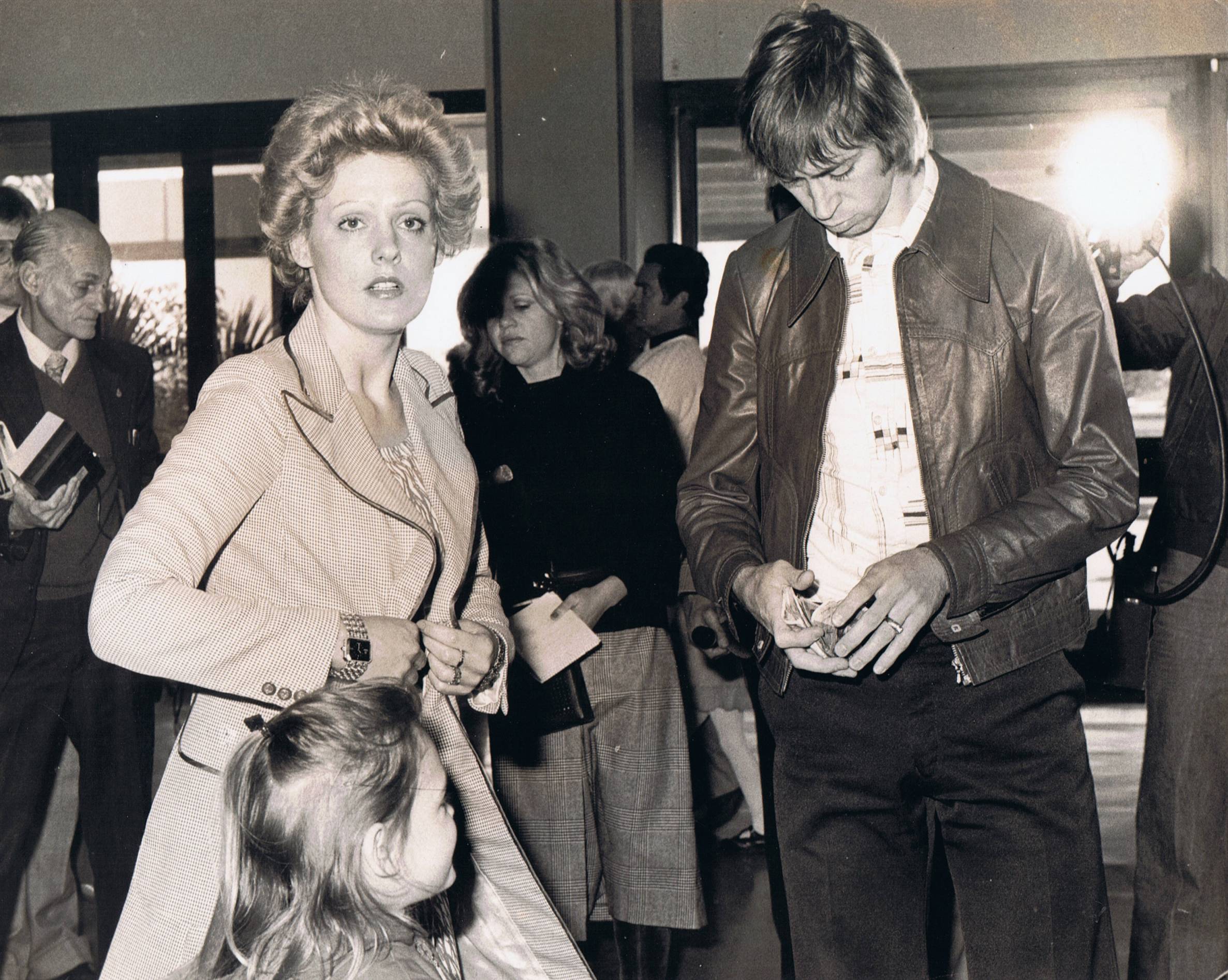
Charlie George leaving Sydney Airport after an NSL stint with St. George
Non British imports also arrived to show their wares. Former Italian stars, the then 36 year old Francesco Graziani (Apia Leichhardt) and 34 year old Nicola Berti (Northern Spirit) were largely ineffectual in the old National Soccer League. Likewise Argentine Osvaldo Ardiles at 33 played just one game for St. George in the NSL – what was the point ? Local clubs were always looking for that big pay day and on field success, but the impact of these former World Cup stars was minimal on both fronts.
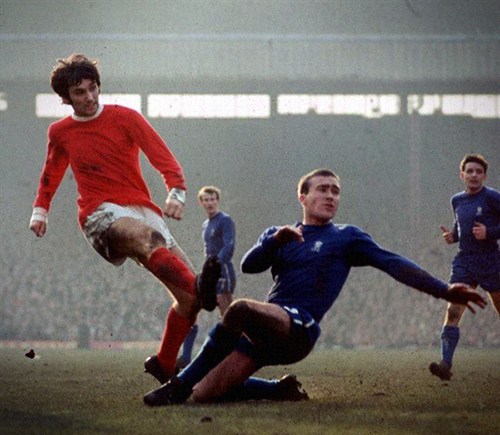
In 1983, a 37 year old George Best, the greatest footballer to have played for an Australian club, made four appearances for Brisbane Lions. Best a former European Footballer of the Year who effectively had retired over 10 years earlier, was a shadow of the wonderful player who dominated British football for nearly a decade. Best increased the gate takings during his brief stay but his impact on the pitch was minimal and Brisbane Lions were none the better for his four outings. The primary purpose of Best’s visit down under was obvious when, on the same trip he turned out for Dee Why a second division NSW State League team against Manly for the sake of a $5,000 match fee. I played against Best that night and although the 2,000 odd spectators enjoyed what was an entertaining game, the presence of a once great footballer on a poorly lit Cromer Park Dee Why, left no legacy for Australian football.
The greatest footballer to have played for an Australian club
The inception of the Hyundai A League brought the “marquee” player – not just a short term guest player but a longer term proposition signed for a season or more. In 2005 the former Manchester United star Dwight Yorke was one of the first and still most successful of the marquee players. Not only did his presence with Sydney FC draw the crowds but his contribution on the field was a catalyst for the club taking out the inaugural A League competition. Yorke scored 7 goals for Sydney FC that season and was the ideal pin up boy for the new league.
Yorke was replaced at Sydney by the Brazilian Juninho. Early on Juninho lit up Aussie (now Allianz) Stadium but a malicious tackle by a Los Angeles Galaxy defender in a meaningless exhibition match, virtually ended his playing career with Sydney. Subsequently Sydney FC employed Nicky Carle, John Aloisi and Brett Emerton on the big money but none of them performed at a level befitting the salaries they were earning. Crowds were average and Sydney FC’s performances likewise.
Not too many clubs earned value for money with their marquee players. Marco Flores was an exception at Adelaide United but when the same club recruited the former Brazilian star Romario briefly in 2007, his almost comical quest to score his 1000th goal, overtook any other apparent reason for his inclusion in the Adelaide line up.
Romario’s fellow countryman, Mario Jardel was signed as the Newcastle Jets marquee in 2007. Jardel arrived with a big reputation but unfortunately an even bigger waistline. It was claimed that Jardel had been working very hard on his fitness prior to joining the Jets, however to see his midriff bursting the stripes of a Jets shirt gave lie to this. Eleven appearances, mostly off the bench with no goals was a sad return for a one time Brazilian international.
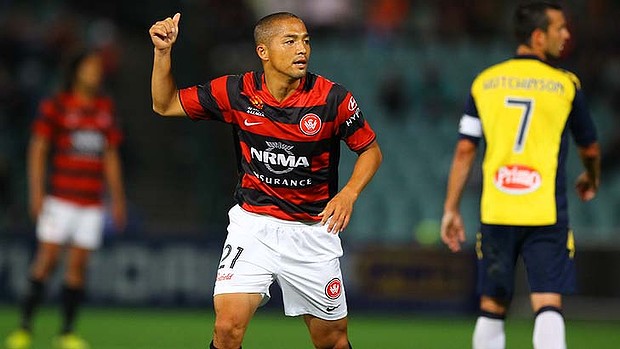
Shinji Ono – a big hit with the Western Sydney Wanderers fans
Former Liverpool star Robbie Fowler was a qualified success in his spell with North Queensland Fury and Perth Glory but with the Fury disappearing from the A League and Perth Glory unconvincing after his departure, there was clearly no long term benefit for Australian football. Shinji Ono performed well for West Sydney Wanderers, Emile Heskey less so for Newcastle Jets. Both players however were in their thirties and they would have been more influential had they arrived a couple of years earlier. Ono and Heskey do deserve credit for the manner in which they promoted their clubs and contributed to the image of the local game. William Gallas likewise at Perth Glory was a handy acquisition though old enough to play local over 35 football.
Harry Kewell, the long time darling of Australian football fans, less so football journalists, arrived back in Australia in August 2011 as Melbourne Victory’s marquee. Kewell returned to much fanfare and expectation but sadly for Kewell and local fans, injury and later family illness cut short his playing stint. When he turned his back on Victory after a truncated unprofitable stay, the journalistic knives were out again.
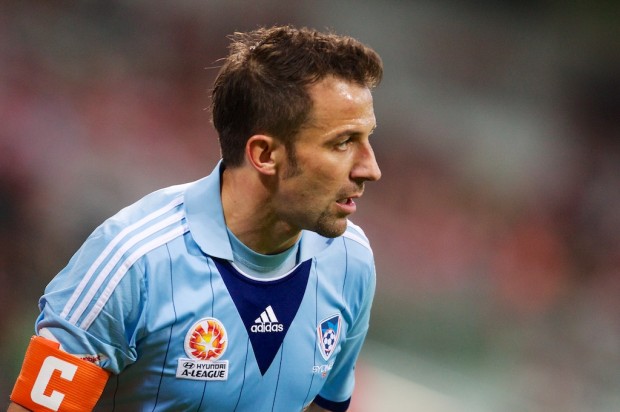
Alessandro Del Piero – The Marquis of Marquees
Alessandro Del Piero, the best credentialed of all A League marquees delivered on many fronts. Certainly in a his first season, sales of Sydney F.C. replica shirts boomed, crowds both home and away surged and the football world at large sat up and took notice of Australian football. Sydney F.C. fans fell in love with “Il Pinturicchio” and Del Piero fell in love with the harbour city. In his first season despite his 38 years, Del Piero showed why he had long been the sweetheart of Italian football. In ADP’s second year a series of niggly injuries, a number of poor team performances and grumblings on the terraces saw the aura of the former Juve superstar dim. Del Piero’s on field contribution became marginal and despite a couple of trademark goals and the occasional marvellous touch or pass, the “use by” date of Alessandro Del Piero was now there for all to see including a few fawning media commentators.
The none too slim Mario Jardel
While few could doubt that the Del Piero marquee project had been a success, that success was tempered by the massive cost to bring him to Sydney FC. The signing of Del Piero could also have been indirectly responsible for the downfall of coaches Ian Crook and then Frank Farina both of whom encountered difficulty in building a successful modern football team around an ageing superstar. Compared to his welcome in September 2012, the Italian star almost sneaked out the back door following a disappointing 2013-14 season finale. Del Piero’s sojourn to Australia however was instrumental in advertising our domestic competition to the world.
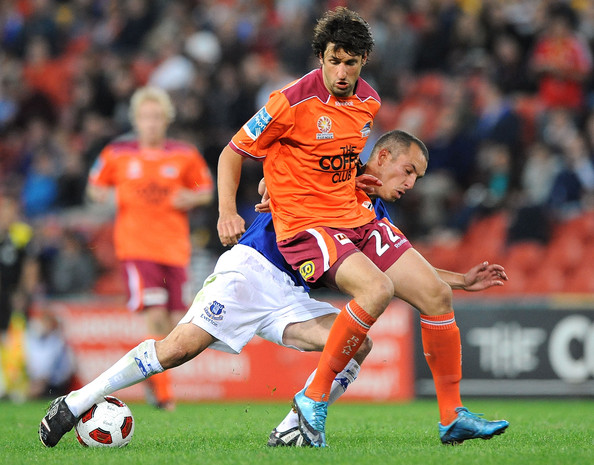
When looking for the prototype marquee player, you need look no further than Brisbane Roar’s Thomas Broich. If the success of a marquee player is measured by on field results, the former German Under 21 international is by far the best example we have seen. Arriving in Australia at the relatively young age of 29, the two time Johnny Warren Medal winner has been a superb player for Brisbane Roar. Primarily due to Broich, Brisbane Roar has been the most successful team in the history of the A League. Yes, Broich has been well paid but he has also paid his dues to Australian football.
Thomas Broich, the most influential import in the history of the A League
Is there a future for the marquee in Australian football ? Is it practical or prudent to pay a massive amount of money for one player who will often be on the wrong side of 30 ? Is the Hyundai A League a retirement village for once talented footballers or have overseas guest or marquee players still got something to offer the local game ? I believe that we should persist with the marquee concept but it is critical that clubs source the right type of player at the right price at the right age. It is imperative that the player can perform consistently at an exceptional level as well as having the “name” and the capacity to attract more patrons to our football grounds. Any more Mario Jardels would be an embarrassment to the Hyundai A League. If however, every club could unearth a Thomas Broich or fund an Alessandro Del Piero or a David Villa, crowds would surely grow, playing standards would lift and Australian club football would prosper.
The lovely Kieran – butter wouldn’t melt in his mouth but ice cream would
One day the MLB and his father had to find an alternative way to get to school, due to a malfunctioning motor vehicle. The father being the wise man that he wasn’t, pinpointed the bus the night before on his surprisingly up to date timetable. The father told the MLB that the bus would pick the two of them up at Sir Thomas Mitchell Drive at 8.32 a.m. There was no doubt in the father’s mind about this Thomas being the pick up point.
Father and MLB stood twenty metres away from the bus stop to avoid the burning sun. The father stood in the shade of a withering bottlebrush and the MLB stood in the shade of his father, standing in the shade of the bottlebrush. When the bus had not appeared by 8.42 a.m. the Ruth, married to the man with a lawnmower welded to his arms, arrived. “Would you like a lift anywhere ?” she said. The father said “No but my wife would like one under her bottom“. After the little bit of banter, father and MLB got into the car. MLB legs, arms, school bag and recently polished Clarks shoes flailing wildly, climbed over the baby seat in the back of the car. Fortunately baby was not on board.
The Ruth said she was going to Forestville which was in the opposite direction, so father and MLB left her company at Forest Way in the hope of sponging another lift. The father approached a young teenage girl standing on the corner watching all the cars going by. “Is this a bus stop?” asked the father with the beads of sweat on his face obviously causing some consternation within the mind of the young girl. When she finally composed herself and looked down at the beautiful blonde boy, she realised that he could not be in the custody of a paedophile. “Yes” she replied.
Although it was a bus stop, the next bus that arrived did not stop at the stop but went around the corner. The father grabbed the bag of the MLB, to which the MLB was attached and hurried after the bus. The driver opened the door as the MLB searched in vain for his new bus pass. MLB was bitterly disappointed that after waiting so long for his pass, he would not get to use it. He was determined to ensure that his mother’s efforts to obtain his bus pass would not be in vain. Five minutes elapsed with the driver saying 43 times “don’t worry about it”. Finally MLB produced the document smothered in Cottees strawberry jam and squashed sandwich remains and held it proudly aloft.
The father saw the beautiful little one get on the bus, praying to Jesus, Mary and Joseph that the very patient bus driver would carry him safely to The Belrose Public School. The father was by now saturated in sweat and carried on his way to meet the $30 million dollar client. The beautiful little MLB arrived safely at school on time.
P.S. The father declared that this was the most humid day of all time and that the “MLB” (Miserable Little Bastard) was really not so.
NORTHERN SPIRIT 0 SYDNEY OLYMPIC 2 Nth. Sydney Oval Friday 9th October 1998
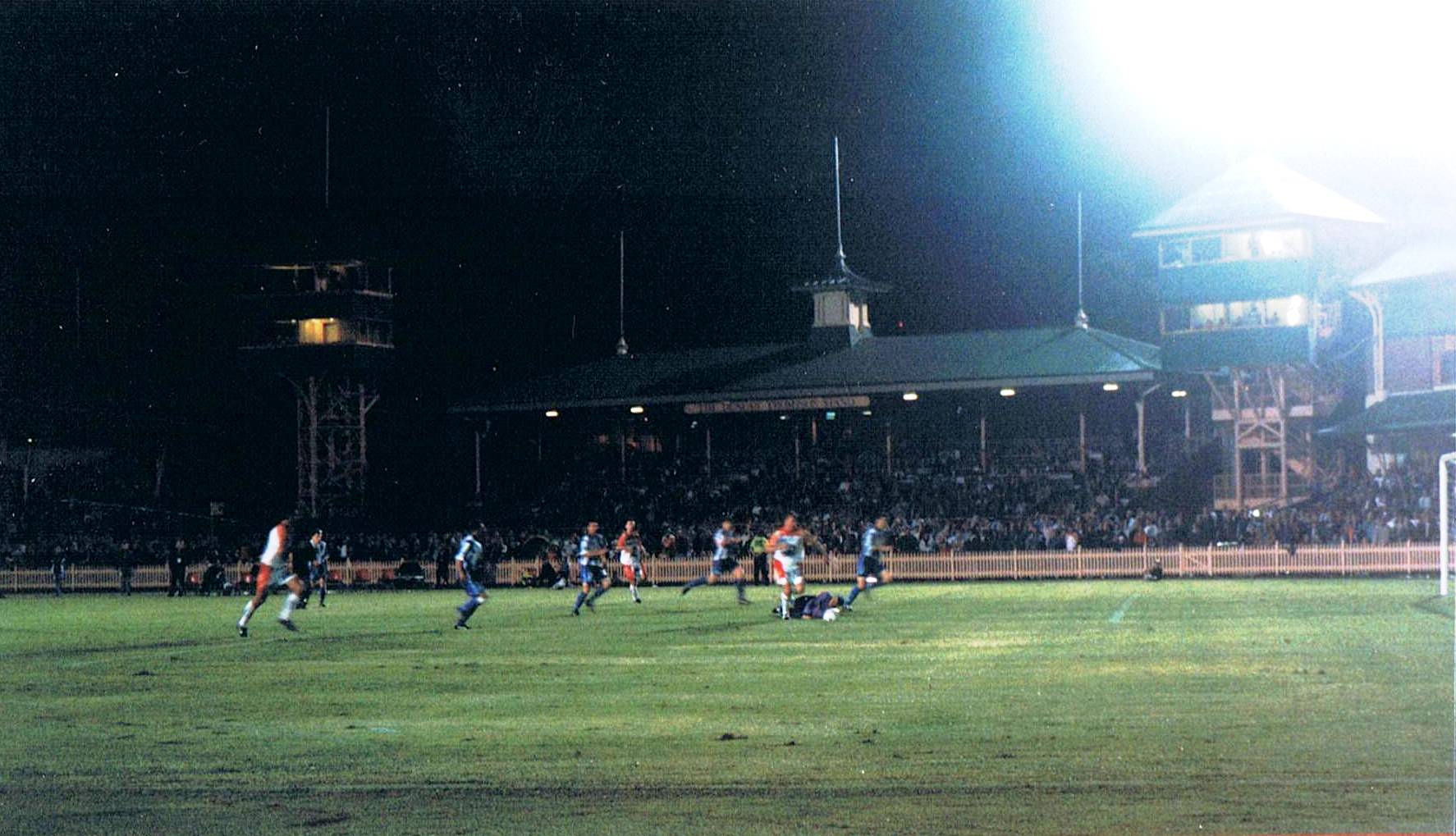
The old sporting spirits of North Sydney Oval welcomed the new generation of the soccer variety last Friday night when Northern Spirit Football Club kicked off their National Soccer League career. Unfortunately, as is often the case on such occasions, the script was altered with Sydney Olympic downing the Spirit 2-0. On this night however, the result was less important than the occasion. Neither the result nor the rain could take the gloss off a wonderful evening. My late father, in his time a strong critic of “Summer Soccer,” would have been delighted to eat humble pie had he been with us at North Sydney Oval.
.The decision of North Sydney Rugby League Club to vacate their home and move to the Central Coast has provided Northern Spirit with a super stadium, a convenient location and a billiard table playing surface. Aside from the cricket pitch area, I have never seen a flatter nor greener pitch. A far cry from the barren, rock hard North Sydney Oval on which I made my grade soccer debut way back in 1968. The ground now was a picture, everything in it’s place even down to the final coat of brilliant white paint on the goalposts.
I have waited 30 years for this night. A night when a team supported by the soccer playing men, women and children outdrew an international rugby league match on the same night. A night when the soccer fraternity of Northern Sydney stood up and was counted – all 18,985 of them. It was a magnificent public response, warmly applauded by the players of both sides after the match.
I went along with my own budding Clayton Zane and Robbie Slater to North Sydney Oval for a night of entertainment and was not disappointed. Despite Olympic fans having a reputation for rather erratic behaviour, I felt very safe among the large good natured, well mannered crowd, most of whom like me had brought the children.
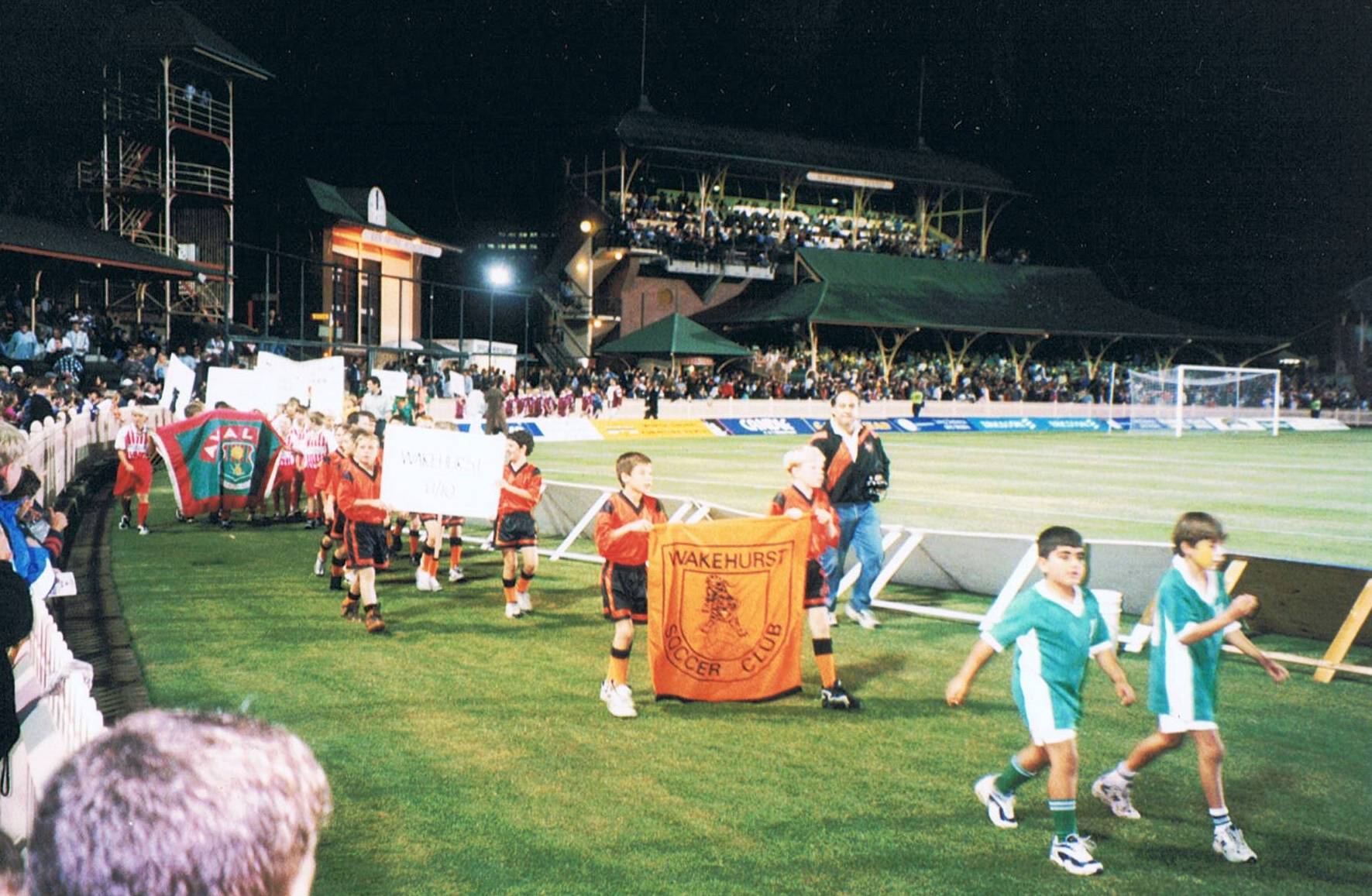
From the opening chords of Merril Bainbridge’s “Under the Water” there was plenty to keep the fans interested. There was the unerring accuracy of the sky divers, the kids at half time throwing themselves kamikaze like at the giant Pepsi Cola ball and the pre match parade of a sprinkling of the thousands of local players who turn out every weekend to play the “World Game”. There was the “Mexican wave” enthusiastically received by the various stands but especially those in the Macartney Stand (obviously no arthritic knees amongst that lot !). We had Olympic fans blasting loud discordant phrases from primitive trumpets and even an Austen Powers imitator offering encouragement from the hill area. This was entertainment – “Yeah baby, yeah !”
The spirit of North Sydney Oval surfaced early. Spirit’s Mark Rudan and Olympic’s Adem Poric were sent off after only 15 minutes as they exacted “hit ups” on each other and a near all in brawl erupted. The spirit of rugby league would not go quietly.
The cricket spirit of North Sydney Oval also raised it’s head when after 27 minutes Kresimir Marusic created a chance for former Socceroo Graham Arnold. The Spirit player coach who obviously had neglected batting practice whilst playing football in the Netherlands sliced his shot to the boundary fence between extra cover and mid off. A straight drive would have been the better option. Even referee Simon Micaleff seemed under the influence of the supernatural, performing an impromptu shimmy in the middle of the cricket pitch area, midway through the first half.
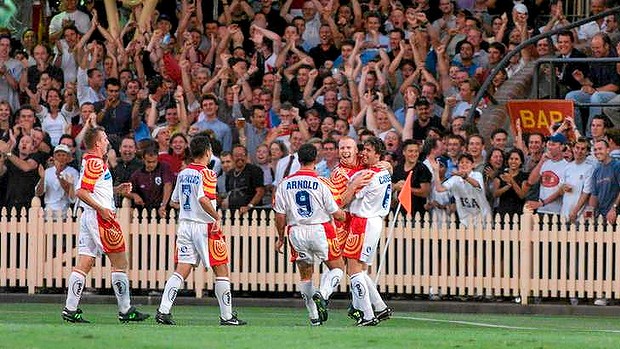
Robbie Slater & colleagues celebrate a goal in 1999 (pic. Tim Clayton)
The fans in “Spirit Point” seemingly inspired by the spirit of John Lennon (ironically on the former Beatle’s birthday) chanted “All we are saying is give us a goal” but unfortunately on this night it was not to be. At half time one had to look twice to realise that the gentlemen vainly trying to shoot balls from point blank range, through a plastic replica of a sponsor’s motor vehicle, were not Spirit strikers.
The spivs trying to sell raincoats in the second half, met with lukewarm response as Olympic snatched two second half goals. Spirit inspired by the tireless Robbie Slater, had several chances to peg back the Olympic lead but tonight was not going to be the night
Graham Arnold withdrew himself from the fray in the second half, probably wondering if this player / coach thing was his “bag”. In the end, their National Soccer League experience, coupled with some clinical finishing by Kalantzis and Cardozo sealed the win for Sydney Olympic. Northern Spirit however showed enough to prove that they will more than hold their own in the National Soccer League this season.
As we streamed away from Bear Park to the strains of Norman Greenbaum’s “Spiritin the Sky”, I reflected on a most enjoyable evening, despite the scoreline and hoped that every one of the 18,985 spectators would return for the next home game in three weeks time – I for one will be there






![ADP[1]](https://djcjack.com/wp-content/uploads/2014/11/adp1.jpg)




 David Jack